

Reseförsäkring Danmark
Som turist är det viktigt att komma ihåg att man har ett ansvar för sin egen resa och säkerhet. En av de viktigaste åtgärderna man kan ta på egen hand är att se till att man har en giltig reseförsäkring om man skulle bli sjuk eller skada sig.
Fakta om Danmark som resmål
Populära städer och regioner
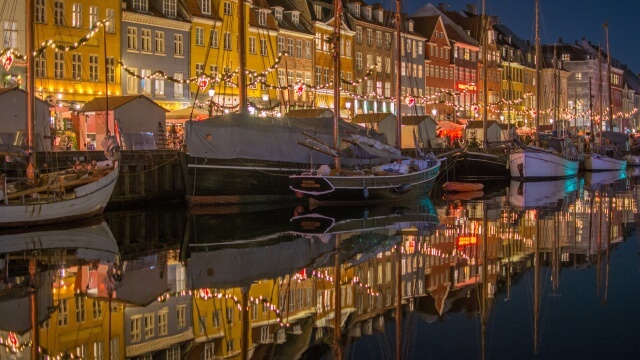
- Köpenhamn: Danmarks huvudstad, känd för sina kanaler, Tivoli, Nyhavn och Den lille havfrue.
- Århus: En livlig stad på Jylland med en rik kultur, universitet och Aros konstmuseum.
- Odense: Födelseplatsen för H.C. Andersen, med charmiga gator och historiska byggnader.
- Aalborg: En viktig stad i norra Jylland, känd för sin vikingahistoria och moderna arkitektur.
- Roskilde: Känd för sin domkyrka och den årliga musikfestivalen, Roskilde Festival.
Klimat och väder
Danmark har ett tempererat kustklimat med milda vintrar och svala somrar. Den bästa tiden att besöka Danmark är mellan maj och september, när vädret är som mest behagligt. Många svenskar reser till Danmark under sommaren och runt jul för att njuta av landets traditionella firanden.
Säkerhet
Danmark anses vara ett av världens tryggaste länder att resa till, men det är alltid bra att vara uppmärksam på sina omgivningar och ta vanliga försiktighetsåtgärder mot ficktjuvar i större städer och turisttäta områden.
Tidszon
Danmark ligger i samma tidszon som Sverige, Central European Time (CET) och Central European Summer Time (CEST).
Populär mat och dryck
- Smørrebrød: Traditionella danska öppna smörgåsar med olika pålägg.
- Rødgrød med fløde: En klassisk dessert gjord på röda bär och serverad med grädde.
- Flæskesteg: En traditionell dansk fläskstek med spröd svål.
- Wienerbrød: En typ av danskt bakverk som är populär världen över.
- Gammel Dansk: En bitter snaps som ofta dricks till frukost eller som aperitif.
Vanliga fraser på danska
- Hej: Hej
- Hejdå: Farvel
- Tack: Tak
- Hur mår du?: Hvordan har du det?
- Ja: Ja
- Nej: Nej
- Skål: Skål
Viktiga restips
- Kontanter och kort: I Danmark är det vanligt att använda kreditkort, men kontanter kan vara bra att ha för mindre inköp och i mindre butiker.
- Dricks: Det är inte nödvändigt att ge dricks i Danmark, eftersom serviceavgift oftast är inkluderad i notan, men det uppskattas om du rundar upp.
- Tåg från Sverige till Danmark: Om du enkelt vill ta dig från Sverige till Danmarks huvudstad tar du enkelt tåget, som stannar i centrala Köpenhamn med gångavstånd till populära nöjesparken Tivoli.
Översikt
Capital: Copenhagen (pop. 1.381 million)
Population: 6,002,507 (2025 est.)
Religions: Evangelical Lutheran (official), Muslim, other/none/unspecified (denominations include Roman Catholic, Jehovah's Witness, Serbian Orthodox Christian, Jewish, Baptist, Buddhist, Church of Jesus Christ, Pentecostal, and nondenominational Christian)
Languages: Danish, Faroese, Greenlandic, German; note: English is the predominant second language
Time Zone: UTC+1; daylight saving time: +1hr, begins last Sunday in March, ends last Sunday in October
Driving side: Right
Calling code: +45
Electrical plug(s): Type C, Type E, Type F and Type K
Pengar
The local currency in Denmark is Danish kroner (DKK). As of 6 October 2026 100 DKK is equal to 15.01 USD.
Currency exchange can be done at banks and exchange offices.
Travellers should be prepared to use credit or debit card to make payments. Note that MobilePay mobile money payments will not work with foreign bank cards. Therefore, it is advisable to carry a small amount of cash for use at markets, in car parks and for other transactions where Danes would use MobilePay. Credit cards are widely accepted. ATMs are available in most places.
Hotel and restaurant personnel are typically not tipped because service charges are included in the bill by law, but a tip of 10% for good service is appreciated. Taxi drivers are not tipped, but you may always round up the fare.
El
The power supply in Denmark is reliable. Electricity operates on 230V at 50Hz using plug type(s) C, E, F and K.
Pass
Most travellers will need a passport to enter Denmark. The passport must be valid for at least three months after the date of departure, have been issued within the last ten years and have two blank pages.
Nationals of the European Union (EU) can enter the Schengen area with a valid ID.
Nationals of Nordic countries are not obliged to hold a passport for entry into Denmark but will need a photo identity document.
Visum
Visa-free entry is available for certain travellers who qualify based on nationality and purpose of travel. All other travellers will need to obtain a visa from the nearest embassy or consulate or apply online (e-visa) prior to travel.
Entry visa requirements vary based on nationality, purpose of travel and other factors. Individual travellers are responsible for ensuring that they comply with all visa requirements, which should be confirmed with authorities at their destination prior to travel.
Visa Free Travel
Visa-free travel to Denmark, Greenland, and the Faroe Islands: Foreign nationals from select countries are allowed entry visa-free to Denmark. The same condition applies to entry to Greenland and the Faroe Islands.
Diplomat, service, and special passport holders can enter visa-free regardless of their nationality.
Visa-free travel within the Schengen area: Citizens of any country that is part of the Schengen agreement can freely enter and reside in any Schengen country without a visa. Some foreign nationals from non-Schengen countries are also allowed entry without a visa, including citizens of the United Kingdom (UK), United States of America (USA), and Canada among others who can enter visa-free for short stays of up to 90 days within a 180-day period.
Visas
Short-stay Schengen Visa (C type): Foreign nationals coming from select countries need a Schengen visa to be allowed entry to any country in the Schengen area.
Travellers are permitted to stay in any of the Schengen zone countries on a single, double or multiple-entry visa, for up to 90 days (three months) during each 180 days period, regardless of the purpose of stay.
Effective 7 November 2025, multi-entry visas are not being issued for Russian citizens.
Visas issued for Schengen countries apply to the entire Schengen area. With a Schengen visa, a third-country national can enter a Schengen country and then travel freely throughout the entire Schengen area, since border checks of persons travelling across the national borders of the Schengen countries have been removed.
Application and processing times may vary depending on the single applicant and the embassy.
Lokal resor
Overview
Copenhagen-Kastrup International Airport (CPH/EKCH) is the main port of entry for travellers and air travel is overall safe. Public transport is multimodal and comprehensive. Roads are maintained to an excellent standard and motorists are generally mindful of road traffic and safety regulations. Cyclists often have the right of way. Though the public transport system is reliable and safe, petty crime is a risk, particularly at airports, train stations and cruise ship quays.
Travel Safety
Air Travel
The majority of international flights to Denmark arrive at Copenhagen-Kastrup International Airport (CPH/EKCH). The facility is located about eight km (five miles) southeast of the city. Security at the airport conforms to all European Union (EU) regulations. Copenhagen is the main hub for SAS, the largest Scandinavian airline.
An efficient rail link connects the airport with the main railway station in Copenhagen. Tickets can be bought from automated machines in the Arrivals Hall. The metro links to the airport and takes 14 minutes. There are also regular bus services from the airport departing every 10 to 20 minutes and taking 20 minutes to reach central Copenhagen. Taxis leave from outside all three terminals and fares include tips. Further information on how to get from the airport to the city can be found here.
A few international flights arriving from other Scandinavian countries or the United Kingdom land at small airports in Århus, Aalborg, Esbjerg and Billund. Domestic flight connections link Copenhagen with Ålborg, Århus, Billund, Bornholm, Karup and Sønderborg. Airlines servicing domestic destinations include SAS (SK) and Sterling Airlines, both of which have good safety records.
Airspace
Following the European Union (EU) Commission announcement that all EU airspace will be closed to Russian-owned, Russian-registered and Russian-controlled aircraft, including private planes and for overflights, all flights to and from Russia will be banned until further notice, in line with EU sanctions on Russia over its invasion of Ukraine.
Borders and Entry
Border measures: Until at least 12 November , authorities are conducting internal border controls, amid an effort to prevent Islamist terrorism threats and organized cross-border crime threats in the border areas. Arrivals, including those from within the Schengen area, may be required to show IDs, passports, visas and additional documentation at all internal borders, especially at ports with ferry connections to Germany.
Identification
Most travellers will need a passport to enter Denmark. The passport must be valid for at least three months after the date of departure, have been issued within the last ten years and have two blank pages.
Travellers are allowed entry with passports where gender is indicated as "neutral". The country's overall social acceptance of LGBTQ people is good.
Road Travel
Traffic in Denmark moves on the right. Roads are maintained to an excellent standard and motorists are generally mindful of road traffic and safety regulations. Danish expressways, highways and secondary roads are maintained to a high standard and connect all areas of the country. Cycling is very popular. Cyclists often have the right of way. You must check cycle lanes before turning right.
A valid foreign driver's license may be used while visiting Denmark, but the driver must be at least 18 years old. An International Driving Permit (IDP) is recommended if you are not an EU national. Many urban streets have traffic lanes reserved for public transport. Unless otherwise noted, the speed limit is 50kph (31mph) in urban areas (signified by white plates with town silhouettes), 80kph (50mph) on open roads and 130kph (81mph) on motorways. In some parts of Copenhagen, including Valby, Vanløse and Gladsaxe, speed limits are 40 kph (25 mph). Driving under the influence of alcohol or drugs is considered a very serious offence. The limit is 0.5 milligrams of alcohol per millilitre of blood. Rules are stringently enforced, and violations can result in stiff fines and possible jail sentences. The use of seat belts is mandatory for drivers and all passengers.
Major road networks connect Copenhagen with Europe; some routes involve ferries, and it is advisable to book these in advance. The 18 km (11 miles) long Great Belt Bridge and tunnel, linking Copenhagen (situated on the island of Sjælland) with the island of Funen, connects Copenhagen to the European continent. A second bridge and tunnel, the Øresund connection, links Copenhagen with Malmø in Sweden. Tolls are applicable for both bridges.
Rail Travel
International trains link Denmark with several countries. Kystbanen, the joint Danish-Swedish trains (also known as the Øresund Train) depart from Copenhagen Central Station three times per hour. A train ferry links Denmark with Hamburg and Lubeck in Germany. The Englænderen boat train runs between Esbjerg and Copenhagen and connects with ferries from the United Kingdom.
A modern and efficient domestic railway system is primarily operated by Danish State Railway (DSB) along with a few smaller private companies. The main cities on all islands are connected to the rail network. This includes Ålborg, Copenhagen, Esbjerg, Herning, Horsens, Odense and Randers. Tickets can be purchased at stations, kiosks and in some instances online. Trains are divided between Intercity (IC) and slower Regional (R) services. Seat reservations are compulsory on IC services unless you board after 20:00. Reservations are not compulsory on R trains and, with the exception of major holidays and the tourist month of July, seats are generally easy to find. DSB also operates express trains called Lyntogs that provide non-stop travel between cities. Precautions should be taken against pickpockets in busy railway stations and on trains.
Public Transport
A combination of railway, bus, ferry and metro systems connect Denmark's major cities with even the most remote areas of the country. Though Denmark's public transport system is reliable and safe, petty crime has been on the rise in recent years, particularly at airports, train stations and cruise ship quays.
Ferries and Boats: International ferries link Denmark to a number of European states. Services include the daily (in high season) and weekly ferries running from Germany (Kiel, Rostock, Puttgarden, Sassnitz-Mukran and the island of Sylt), Iceland (Seydisfjördur), Norway (Oslo, Kristiansand, Bergen and Larvik), Sweden (Helsingborg, Gothenburg, Varberg and Malmø), Poland (Sáwinoujácie) and the UK (Harwich). Services are generally reliable; however, they may be disrupted during winter due to inclement weather.
Domestically, local car ferries link most islands to the road network. There are frequent ferry sailings from Kalundborg to Århus, Ebeltoft to Sjællands Odde and Rønne to Copenhagen. The principal domestic ferry operator is Scandlines. Ferries to Bornholm Island are operated by Bornholmstrafikken. All ferries in Denmark can be considered safe, as government and EU regulations must be adhered to for a vessel to operate.
Buses: International bus services link Denmark to Germany. Buses also connect Denmark to the rest of Scandinavia via the Øresundsforbindelsen (Øresund Fixed Link) road-rail system connecting Malmø in Sweden and Copenhagen. Buses are generally recent models with good safety records.
Most areas within Denmark are linked by an efficient regional bus service with Copenhagen as the main hub. Longer trips can often be made quicker by bus than by train, as bus routes can be more direct. Major bus companies include Nordjyllands Trafikselskab, HurtigBussen, Thinggaard Expres, Søndergaards Busser and Abildskous Busser. Combining a trip by rail and bus is very simple as train tickets can cover onward travel by bus.
Bus networks operate within larger Danish towns. In Copenhagen, all public transport buses are yellow with an entrance located at the front. Bus stops are marked with yellow signs. There are several different types of bus services available, including night buses operating from 01:00 to 05:00 in Copenhagen and surrounding towns. Most buses are modern and well-maintained.
Metro: The Copenhagen Metro is a driverless light metro system composed of two lines: M1 and M2.
The M1 line runs from Vanløse in the western part of the city to Vestamager in the south. It passes through key areas such as Frederiksberg, Nørreport and Islands Brygge. The M2 line runs from Vanløse to Copenhagen Airport. It also passes through central areas like Nørreport, Kongens Nytorv and Christianshavn.
Further information on tickets, schedules and zones can be found here.
Metro stations are marked with a red 'M'. Riders must have a valid ticket or use a Rejsekort electronic fare card before entering station platforms; ticket machines are available at all stations and the fare system is integrated with other forms of public transport, including buses and suburban rail. The system operates continuously through the night, however times between trains are increased to between 15 and 20 minutes from 00:00 to 05:00. Travelling in the metro is generally safe, but it is advisable to be on guard against theft.
Taxis: Taxis are widely available and safe. Taxis can be hailed on the street, picked up at taxi stands or booked in advance. The fare displayed on the taxi meter is inclusive of VAT and tip but additional fees will be charged for transportation of luggage if it is placed on the exterior of the vehicle, if the driver provides assistance with luggage, or if a cab is requested to transport a bicycle or pram. Official vacant taxis carry the sign 'Fri' (free) in the window and have a green light on top of the car.
Vehicle Hire: Many local and international vehicle rental companies operate in Denmark, including Avis, Budget, Europcar and Hertz. Branches are located all over the country. The minimum age for car rental is 21. Renters under 23 years of age may be required to pay a young driver’s fee.
Movement Control Orders
Travel in remote and environmentally sensitive areas of Greenland is limited. Visitors who wish to explore glaciers, mountains or the North-East Greenland National Park require a special permit. Applications should be made to the Ministry of Foreign Affairs, Asiatisk Plads 2, 1448 Copenhagen (tel.: 45 33-92-00-00 or 33-92-04-21) or via contacts on the Government website.
Landsinformationen på denna webbplats har översatts med hjälp av maskinöversättning av vår partner. Arbete har utförts för att tillhandahålla en så korrekt översättning som möjligt, dock ska du som läsare ha i åtanke och acceptera att ingen automatisk översättning är perfekt och bör inte heller läsas eller tolkas som så. Landsinformationen är inte avsedd att vara en källa till råd eller handling baserat på det material som presenteras. Ingen garanti antyds eller ges, inga anspråk eller rättsliga åtgärder accepteras.

- {{originalfilename}} x
Kan jag boka försäkring till landet?
Våra försäkringar gäller inte vid resa till område som Utrikesdepartementet i sina rekommendationer avråder från att besöka eller vistas i. Vänligen se listan UD avråder för mer information.