

Fakta om Kanada som resmål
Kanada är världens näst största land till ytan och sträcker sig från Atlanten i öst till Stilla havet i väst, samt norrut mot Arktis. Landet är uppdelat i tio provinser och tre territorier, var och en med sin egen unika charm och sevärdheter.
Städer och regioner
Kanada har flera ikoniska städer och regioner som är värda ett besök:
- Toronto: Landets största stad och ett kulturellt centrum med en mångkulturell befolkning. Staden är känd för CN Tower och dess pulserande stadsdelar.
- Vancouver: Belägen på västkusten, välkänd för sin spektakulära natur och närheten till både hav och berg.
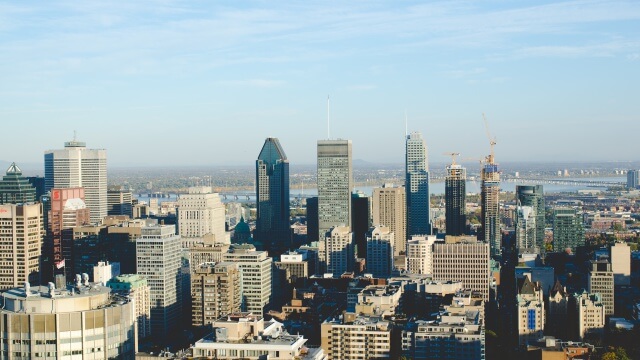
- Montreal: En fransktalande stad känd för sin rika historia, arkitektur och livliga konstscen.
- Québec City: En av de äldsta städerna i Nordamerika, belägen i provinsen Québec, känd för sin välbevarade gamla stadsdel och europeiska influenser.
- Nationalparkerna Banff och Jasper: Båda belägna i Alberta, kända för sina spektakulära landskap som täcks av glaciärer, berg och sjöar.
Klimat och väder
Kanada har ett mycket varierat klimat beroende på region och årstid. Vintrarna kan vara mycket kalla, särskilt i de norra och centrala delarna av landet, med temperaturer som kan sjunka långt under noll grader. Somrarna är varmare, särskilt i södra Kanada, där temperaturerna kan nå över 25 grader. Hösten (september-november) är en särskilt vacker tid att besöka södra Kanada, när landskapet täcks av färgsprakande lövverk tack vare dess många lövträd - vilket förklarar lönnlövet i Kanadas flagga.
Språk
Kanada har två officiella språk: engelska och franska. Engelska är det mest talade språket i större delen av landet, medan franska är dominerande i provinsen Québec.
Vanliga fraser på franska:
- Hej: Bonjour
- Hejdå: Au revoir
- Tack: Merci
- Hur mår du?: Comment ça va?
- Ja: Oui
- Nej: Non
- Skål: Santé
Säkerhet
Kanada är generellt sett ett säkert land att resa till, med sina vänliga invånare och låga brottslighet. Dock är det alltid viktigt att vara försiktig, särskilt i stora städer och turistområden. I naturen bör man vara medveten om att det kan finnas vilda djur som björnar och älgar, och vid expeditioner eller vandringar i nationalparker bör man förbereda sig med rätt utrustning och vidta lämpliga försiktighetsåtgärder.
Reseförsäkring till Kanada
Reseförsäkring till Kanada är nödvändig för att känna sig trygg om någon oväntad händelse skulle inträffa, såsom sjukdom, olyckor eller förlorat bagage. Sjukvården i Kanada håller hög standard men som turist kan kostnaderna bli höga, särskilt om du behöver akut vård eller specialistbehandling. Med en Reseförsäkring Bas/Plus från Europeiska ERV kan du anpassa din reseförsäkring efter dina behov, så att du kan känna dig trygg under din resa. Planerar du att utföra någon extremsport, inklusive skidåkning, kan en Extremsportförsäkring vara aktuellt.
Viktiga restips
- Visum: Svenska medborgare behöver ett ETA (Electronic Travel Authorization) för att resa till Kanada. Detta ansöker du om online innan avresa.
- Betalningsmedel: Kreditkort accepteras generellt sett i hela Kanada, men det är klokt att ta med kontanter för mindre köp. Uttagsautomater finns ofta tillgängliga i de flesta städer och regioner.
- Vaccinationer: Inga speciella vaccinationer krävs för att resa till Kanada, men det är alltid bra att ha grundvaccinationer uppdaterade.
- Bilkörning: Kanada har högertrafik. Om du planerar att hyra bil, se till att du har ett giltigt körkort och känner till de lokala trafikreglerna.
- Eluttag: Kanada använder 120V med tvåpoliga uttag. Adapter kan behövas om du reser från Europa.
Reseförsäkring Kanada
Som turist är det viktigt att komma ihåg att man har ett ansvar för sin egen resa och säkerhet. En av de viktigaste åtgärderna man kan ta på egen hand är att se till att man har en giltig reseförsäkring om man skulle bli sjuk eller skada sig.
Översikt
Capital: Ottawa (pop. 1.437 million)
Population: 40,126,723 (2025 est.)
Other Urban Areas: Toronto (pop. 6.372 million); Montreal (pop. 4.308 million); Vancouver (pop. 2.657 million); Calgary (pop. 1.640 million); Edmonton (pop. 1.544 million)
Religions: Catholic, Protestant, Orthodox, other Christian, Muslim, Hindu, Sikh, Buddhist, Jewish
Languages: English, French, Punjabi, Italian, Spanish, German, Cantonese, Tagalog, Arabic
Time Zone: UTC -7, -6, -5, -4, -3 going from West to East
Driving side: Right
Calling code: +1
Electrical plug(s): Type A and Type B
Pengar
The local currency in Canada is Canadian dollars (CAD). As of 6 October 2026 100 CAD is equal to 70.1 USD. In addition to the local currency, USD may be accepted for payment in some places.
Currency exchange can be done at banks.
Travellers should be prepared to use either cash or credit or debit card to make payments. Credit cards are widely accepted. ATMs are available in most places.
Banking hours are 10:00-16:00 from Monday to Thursday and 10:00-18:00 on Friday. While entering or leaving, tourists must declare any money or monetary instruments, such as stocks, bond or cheques valued at $10,000 or more that they may be carrying.
Tipping 15-20% is expected at restaurants. Round up to the nearest $5 (CAD) whenever you take a taxi and $1-2 (CAD) per bag is expected for bellhops. A housekeeping tip may be included in hotel bills. If not, leave $5 (CAD) a day or a lump sum at the end of your stay.
El
The power supply in Canada is reliable. Electricity operates on 120V at 60Hz using plug type(s) A and B.
Pass
Most travellers will need a passport to enter Canada. The passport must be valid for the duration of the stay and have one blank page.
Nationals of the US can enter Canada with a valid passport card, NEXUS Card or Permanent Resident Card, via mutual land border crossings.
Visum
Visa-free entry is available for certain travellers who qualify based on nationality and purpose of travel. Travellers may qualify for a visa waiver, however this requires the completion of a security check or travel authorisation prior to departure. All other travellers will need to obtain a visa from the nearest embassy or consulate or apply online (e-visa) prior to travel.
Entry visa requirements vary based on nationality, purpose of travel and other factors. Individual travellers are responsible for ensuring that they comply with all visa requirements, which should be confirmed with authorities at their destination prior to travel.
Visa Free Travel
Visa-Free Travel to Canada: US citizens may enter Canada for up to six months in most cases without obtaining an entry visa or completing an electronic Travel Authorisation.
Visa Waivers
Electronic Travel Authorisation (eTA): Foreign nationals from select countries must apply for an Electronic Travel Authorisation (eTA) to enter for up to six months,
- Romanian nationals may obtain an eTA only if they have an electronic passport;
- Taiwan nationals may obtain an eTA only if they have an ordinary passport issued by the Ministry of Foreign Affairs in Taiwan that includes the personal identification number;
- Nationals of Argentina, Antigua and Barbuda, Costa Rica, Mexico, Morocco, Panama, St. Kitts and Nevis, St. Lucia, St. Vincent and the Grenadines, Seychelles, Thailand, Trinidad and Tobago, Uruguay and the Philippines can apply for an eTA only if they held a Canadian visa in the last 10 years or currently hold a valid non-immigrant visa issued by the United States (US) officials.
Visas
Visitor Visa - Entry: Foreign nationals from select countries must obtain a visitor visa (also called a temporary residence visa) to enter Canada via any method of travel, in most cases for up to six months.
Lokal resor
Overview
Travel throughout Canada is generally safe, although it can be time-consuming due to the vast size of the country. Road networks are in good condition, especially in cities and on first-class express highways. Winter conditions and wildlife can make driving hazardous at times.
Travel Safety
Air Travel
Canada has 13 officially designated international airports, with the main international hubs in Montreal (YUL/CYUL), Toronto (YYZ/CYYZ), Calgary (YYC/CYYC) and Vancouver (YVR/CYVR). Other hubs include Edmonton (YEG/CYEG), Fredericton (YFC/CYFC), Gander (YQX/CYQX), Halifax (YHZ/CYHZ), Moncton (YQM/CYQM), Ottawa (YOW/CYOW), Quebec (YQB/CYQB), St John's (YYT/CYTT) and Winnipeg (YWG/CYWG). The principal national airline is Air Canada and its subsidiary Air Canada Express (Jazz Aviation); Sunwing Airlines and United, Delta and American Airlines also provide extensive service throughout North America and the Caribbean. WestJet, Air Transat, Air North and Flair and Porter Airlines are among the major regional carriers, based out of Alberta, Quebec, Yukon and Ontario, respectively. Travel to more remote areas in northern and western Canada, where many smaller communities are only safely accessible by plane year-round, is available through a large number of private charters and air ambulances.
Montreal-Trudeau International Airport (YUL/CYUL) is located approximately 20km (12 miles) from the city centre. Good security measures are in place at the airport, although queues can be long. Allow plenty of time to arrive at the airport before your flight departure time. Public transport options from the airport to the city centre include an airport bus, public bus, shuttles and taxis.
Toronto Pearson International Airport (YYZ/CYYZ) is located 27km (17 miles) from the city centre. It is the largest and busiest airport in the country providing over 100 nonstop, international flight services. Allow plenty of time before your flight is scheduled to depart as security checks can be lengthy. Transport options from the airport to the city centre include public buses, airport buses, Union Pearson Express trains, shuttles and taxis.
Calgary International Airport (YYC/CYYC) is located approximately 17km (12 miles) from the city centre. Queues are well managed and security checks are prompt and efficient. The airport has an excellent safety record. Allow plenty of time before your flight is scheduled to depart as security checks can be lengthy. Public transport options from the airport to the city centre include public buses, airport buses, shuttles and taxis.
Vancouver International Airport (YVR/CYVR) is located approximately 12km (7.5 miles) from the city centre. Allow plenty of time before your flight is scheduled to depart as security checks can be lengthy.Public transport options from the airport to the city centre include airport buses, public buses, SkyTrain light rail, shuttles and taxis.
Borders and Entry
Health-related surveillance measures: Authorities implement Ebola surveillance measures at the country's ports of entry, effective until further notice, to prevent the entry of the disease. Inbound travellers who have been to the affected regions are asked to monitor their symptoms for at least 21 days. Effective 30 May, inbound travellers who have visited countries affected by Ebola within the past three weeks are asked to self-isolate for at least 21 days. Foreign nationals who have visited or transited through the Democratic Republic of the Congo are banned from entering the country, until at least 28 November.
Identification
Most travellers will need a passport to enter Canada. The passport must be valid for the duration of the stay and have one blank page.
Travellers are allowed entry with passports where gender is indicated as "neutral". The country's overall social acceptance of LGBTQ people is good.
The following documents are considered unreliable and are not valid for travel to Canada: any passport issued by Somalia; non-machine readable passports issued by the Czech Republic; temporary passports issued by the Republic of South Africa; provisional passports issued by Venezuela.
Road Travel
Traffic moves on the right. Canada’s expansive network of over 12,500km (7,767 miles) of primary roads is well-maintained and considered in excellent condition. On country roads, drivers should be mindful of animal crossings, especially at night. The Canadian Automobile Association is a resource for visitors who plan to drive while in Canada.
Each province in Canada is subject to its own traffic laws; for example, right turns on a red light are not legal in some parts of Quebec. However, there are many general standards that apply across the country. Speed limits are generally 50kph (31 mph) in cities and towns, 80kph (49 mph) on rural two-lane highways, and up to 110kph (68 mph) on separated express highways. Radar detection devices are prohibited in most areas and all vehicles must have automatic daytime running lights. Penalties can include fines, licence suspension, and even vehicle impound. Some provinces have introduced a new law whereby a fine between CAD2,000-10,000 (USD1,580-USD7,910) can be given to any driver going 50kph (31 mph) over the speed limit. It is prohibited from talking on a mobile phone while driving, unless on a hands-free device, in the provinces of Newfoundland and Labrador, Nova Scotia, Quebec, Ontario, Saskatchewan and British Columbia. Seatbelts are mandatory for drivers and all passengers. Children must sit in a proper child safety seat.
Foreign nationals may drive on national driving licences for a period of up to three months in most Canadian provinces, after which a Canadian driver’s licence must be obtained.
Winter road conditions can be extreme. Travellers are advised to monitor local weather conditions before setting out to drive. Snow tyres are required in some provinces and territories; in Quebec, it is mandatory for all vehicles to be outfitted with snow tyres from 15 December to 15 March.
Rail Travel
Via Rail operates intercity lines across the country. Passengers should make reservations in advance. Via Rail trains offer different class services as well as sleeper cabins. International trains to the US are jointly operated by Amtrak and Via Rail out of Toronto, Vancouver and Montreal. Always make sure you lock your cabin when exiting and take all your valuables with you.
Edmonton, Calgary, Ottawa, Toronto, Cambridge, Kitchener and Waterloo offer streetcar and light rail connecting their city centres to suburban areas. Daily commuter rail lines operate in the Vancouver, Montreal and Toronto metropolitan areas. These services tend to be safe and efficient. Petty crime can occur so always keep your valuables in a secured pocket.
Public Transport
Ferries and Boats: International ferries services link British Columbia with Alaska and Washington in the US. Other small ferries link Ontario with New York state. On the eastern coast several cruise ship lines operate between Halifax and the eastern US. Domestic passenger inter- and intra-city ferries are available across Canada. All vessels have good safety standards and are regulated effectively. However, as a general precaution never board a vessel that does not appear seaworthy or seems to be overcrowded.
Buses: Long-distance bus lines, while not exceptionally comfortable, offer extensive services across the country, serving some 1,100 points in Canada. A number of other regional bus services are available. All major cities have efficient public bus networks. Some cities will have express buses, airport link connections and night buses, while other, smaller cities may have more limited services. Petty crime can occur on buses but it is usually not a regular occurrence. However, you should always ensure you keep your valuables in a secured pocket.
Metro: Toronto, Montreal and Vancouver have metro systems. All services are safe, clean, efficient and easy to use with contactless payment options. In Toronto, trains run from 06:00 to 02:00 local time daily, except on Sundays, when the service begins at 08:00 local time; trains pass through stations every two to six minutes. In Montreal, trains run from 05:30 to 01:00 local time daily and pass through stations every three to 10 minutes. In Vancouver, trains run from 05:30 to 01:30 Monday to Friday, 06:00 to 01:30 on Saturdays and 07:00-00:30 on Sundays and public holidays.
Taxis: Taxis in Canada generally operate on a fare by meter basis. As there are many companies across the country, travellers are advised to review taxi options in the city of their destination. Unofficial taxis tend to not be a problem in Canadian cities. Taxis can be hailed on the street, found at designated taxi stands or called for by phone. There have been a few incidents of taxi drivers robbing passengers, but these tend to be a rare occurrence. Always make a mental note of the roof-top taxi number before entering the vehicle and the company name in case you become a victim of a robbery. Ride-share services are also available in most urban areas.
Vehicle Hire: All major international car rental companies operate in Canada. Offices are generally located at airports or can be located through hotel chains. Full licence holders over 21 years are able to rent under Canadian law but some companies may require that drivers are at least 25 years old.
Landsinformationen på denna webbplats har översatts med hjälp av maskinöversättning av vår partner. Arbete har utförts för att tillhandahålla en så korrekt översättning som möjligt, dock ska du som läsare ha i åtanke och acceptera att ingen automatisk översättning är perfekt och bör inte heller läsas eller tolkas som så. Landsinformationen är inte avsedd att vara en källa till råd eller handling baserat på det material som presenteras. Ingen garanti antyds eller ges, inga anspråk eller rättsliga åtgärder accepteras.

- {{originalfilename}} x
Närmaste servicekontor
Euro-Center New York
Kan jag boka försäkring till landet?
Våra försäkringar gäller inte vid resa till område som Utrikesdepartementet i sina rekommendationer avråder från att besöka eller vistas i. Vänligen se listan UD avråder för mer information.