

Reseförsäkring Argentina
Som turist är det viktigt att komma ihåg att man har ett ansvar för sin egen resa och säkerhet. En av de viktigaste åtgärderna man kan ta på egen hand är att se till att man har en giltig reseförsäkring om man skulle bli sjuk eller skada sig.
Fakta om Argentina som resmål
Populära städer och regioner
Argentina har många spännande städer och regioner att utforska:
- Buenos Aires: Argentinas huvudstad, känd för sina skickliga tangodansare, sin europeiskt inspirerande arkitektur och sitt livliga nattliv.
- Mendoza: En region känd för sina vingårdar och Malbec-viner, samt för sin närhet till Anderna och goda möjligheter till bergsklättring.
- Patagonien: Ett vidsträckt område i södra Argentina med spektakulära landskap, glaciärer och nationalparker som Los Glaciares och Torres del Paine.
- Iguazúfallen: Ett vattenfall beläget i nordöstra Argentina vid gränsen till Brasilien och är ett av världens mest imponerande vattenfall.
- Córdoba: En stad med rik kolonial historia som speglas i arkitekturen. Staden är en perfekt utgångspunkt för friluftsentusiaster som planerar att utforska Sierras de Córdoba-bergen.
Klimat och väder
Argentina har ett varierat klimat beroende på region. I norr, som i Iguazúområdet, är klimatet tropiskt och fuktigt, medan centrala Argentina, inklusive Buenos Aires, har ett tempererat klimat med varma somrar och milda vintrar. I södra Argentina, särskilt i Patagonien, är klimatet kallare och mer blåsigt, med hårda vintrar och kyliga somrar. Det är viktigt att packa kläder för olika väderförhållanden beroende på vilka regioner du planerar att besöka. Våren (september till november) och hösten (mars till maj) är ofta de bästa tiderna att resa för att undvika extrem värme eller kyla.
Säkerhet
Argentina är generellt ett säkert resmål, men som i alla större städer bör du vara medveten om småbrott som ficktjuvar, särskilt i turisttäta områden som Buenos Aires. Det är också bra att undvika att bära dyra smycken eller stora summor pengar. I mer avlägsna områden, som Patagonien, är säkerheten hög, men det är viktigt att vara väl förberedd och ha en guide om du planerar att utforska vildmarken.
Tidsskillnad från Sverige
Argentina ligger 4 timmar efter Sverige under svensk vintertid (CET) och 5 timmar efter under svensk sommartid (CEST).
Populär mat och dryck
Argentina är känt för sin matkultur, särskilt för sitt grillade kött och röda viner. Här är några rätter och drycker du inte bör missa:
- Asado: En argentinsk grillfest med olika typer av kött, vanligtvis nötkött, grillat över öppen eld.
- Empanadas: Små degknyten fyllda med kött, ost eller andra ingredienser, som är populära över hela landet.
- Mate: En traditionell sydamerikansk dryck gjord på yerba mate, som dricks genom en metallrör ur en kalebasskål.
- Dulce de leche: En söt mjölkbaserad karamellkräm som används i många desserter och bakverk.
- Malbec-vin: Argentina är en av världens största producenter av Malbec, ett rött vin som är särskilt populärt i Mendoza-regionen.
Vanliga fraser på spanska
I Argentina talas huvudsakligen spanska, men den argentinska versionen har en distinkt accent och vissa unika ord och fraser. Här är några användbara fraser på spanska:
- Hej: Hola
- Hejdå: Adiós
- Tack: Gracias
- Hur mår du?: ¿Cómo estás?
- Ja: Sí
- Nej: No
- Skål: ¡Salud!
Reseförsäkring till Argentina
Att ha en pålitlig reseförsäkring när du reser till Argentina är viktigt. Det skyddar dig mot oförutsedda händelser såsom sjukdom, olyckor eller förlorat bagage. Se till att din försäkring täcker de aktiviteter du planerar att utföra under din resa, särskilt om du planerar att delta i äventyrliga aktiviteter som bergsklättring eller vandring i avlägsna områden. Läs mer om vår Extremsportförsäkring och vilka typer av aktiviteter den omfattar.
Viktiga resetips
- Valutaväxling och betalningar: Den lokala valutan är argentinsk peso (ARS). Det är vanligt att använda kontanter, men kreditkort accepteras på de flesta hotell och restauranger i större städer. Var medveten om att växelkursen kan variera kraftigt mellan officiella och inofficiella växelkontor.
- Trafik och transport: I Buenos Aires är kollektivtrafiken väl utbyggd med bussar och tunnelbana (subte), men trafiken kan vara intensiv och rörig. Taxis och ride-sharing-tjänster som Uber är också vanligt förekommande. I mer avlägsna områden är hyrbil eller långfärdsbussar de vanligaste transportmedlen.
- Hälsoskydd: Vattnet i större städer som Buenos Aires är säkert att dricka, men på landsbygden är det bäst att hålla sig till buteljerat vatten. Vaccin mot gula febern rekommenderas om du planerar att besöka vissa delar av norra Argentina, som området runt Iguazúfallen.
- Lokala seder: Argentinarna är generellt sett varma och gästvänliga. Att hälsa med en kyss på kinden är vanligt, även vid första mötet. Måltider äts ofta sent, med middag serverad runt 21:00 eller senare.
Översikt
Capital: Buenos Aires (pop. 15.490 million)
Population: 45,851,378 (2025 est.)
Other Urban Areas: Córdoba (pop. 1.612 million); Rosario (pop. 1.594 million); Mendoza (pop. 1.226 million); San Miguel De Tucumán (pop. 1.027 million); La Plata (pop. 914,000)
Religions: Roman Catholic, Evangelical
Languages: Spanish, Italian, English, German, French, Indigenous (Mapudungun, Quechua)
Time Zone: UTC-3
Driving side: Right
Calling code: +54
Electrical plug(s): Type I
Pengar
The local currency in Argentina is Pesos (ARS). As of 6 October 2026 100 ARS is equal to 0.07 USD.
Currency exchange can be done at banks and exchange offices.
Travellers should be prepared to use either cash or credit or debit card to make payments. Credit cards are widely accepted. ATMs are available in most places.
Exchanging money with informal traders (Dollar Blue) is not advised since counterfeiting is a problem. Fake bills are also an issue, travellers should be alert on all their trading. Furthermore, visitors should bear in mind that travellers' cheques may not always be accepted and that photo identification and a photocopy of the passport may be necessary when they use credit cards. When travelling, carrying too much cash, expensive watches, jewellery and cameras is inadvisable while locking luggage and keeping passports in a safe is recommended.
Tipping is not required, but common for good service. Conventionally, 10% tips are appropriate at restaurants, and leaving the change is normal for taxi cabs. Tip hotel doormen the equivalent of $1 (USD) per bag, and hotel maids the equivalent of $2-3 (USD) a day. A 10-20% tip for tour guides is appropriate.
El
The power supply in Argentina is reliable. Electricity operates on 220V at 50Hz using plug type(s) I. Buildings have a mix of European and Australian plug fittings and adaptors are needed by visitors coming from many different places of the world.
Pass
Most travellers will need a passport to enter Argentina. The passport must be valid for at least six months after the date of arrival and have two blank pages.
Nationals of MERCOSUR countries can enter Argentina with a valid ID.
Nationals of Venezuela can enter Argentina with a valid ID.
Visum
Visa-free entry is available for certain travellers who qualify based on nationality and purpose of travel. All other travellers will need to obtain a visa from the nearest embassy or consulate or apply online (e-visa) prior to travel.
Entry visa requirements vary based on nationality, purpose of travel and other factors. Individual travellers are responsible for ensuring that they comply with all visa requirements, which should be confirmed with authorities at their destination prior to travel.
Visa Free Travel
Visa Free Travel to Argentina (30 days): Foreign nationals from select countries may enter Argentina for tourist purposes for up to 30 days.
Visa Free Travel to Argentina (60 days): Foreign nationals from Venezuela may enter Argentina visa-free for tourist purposes for up to 60 days.
Visa Free Travel to Argentina (90 days): Foreign nationals from select countries may enter Argentina for tourist purposes for up to 90 days.
e-Visas
Electronic Travel Authorisation (AVE): Foreign nationals from select countries who hold a US visa or who have entered the US at least once during the two years before travel to Argentina may obtain an Electronic Travel Authorisation (AVE) instead of a tourist visa to be permitted entry to Argentina for up to 90 days.
Chinese, Dominican and Indian nationals holding a valid visa issued by the United States may enter Argentina without an Electronic Travel Authorisation (AVE) for tourist purposes. Chinese citizens can stay for up to 30 days, whereas Dominicans and Indians can stay for 90 days.
Visas
Entry Visa: Foreign nationals from select countries must obtain a tourist visa to gain entry to Argentina for up to 90 days. Travellers must submit their visa application in person at an Argentinian consulate.
Chinese, Dominican and Indian nationals holding a valid visa issued by the United States may enter Argentina without a visa for tourist purposes. Chinese citizens can stay for up to 30 days, whereas Dominicans and Indians can stay for 90 days.
Lokal resor
Overview
The main point of entry for travellers is Buenos aires's Ministro Pistarini de Ezeiza International Airport (EZE/SAEZ). Flights are recommended for long-distance travel to reduce travelling time. Overall, driving is considered risky for inexperienced drivers since locals are known to drive aggressively and recklessly, particularly in Buenos Aires. Public transport systems are generally safe and efficient, although petty crime such as pickpocketing can occur; it is recommended that city bus travel is avoided at night for this reason.Travellers should avoid hailing a cab or 'remis' from the street, to reduce the risk of robberies and route/fare scams.
Travel Safety
Air Travel
Most travellers arrive in Buenos Aires' Ministro Pistarini de Ezeiza International Airport (EZE/SAEZ), commonly referred to as simply Ezeiza. Serving as a hub for Aerolíneas Argentinas and Flybondi.
Ezeiza is located approximately 33km (21 miles) from central Buenos Aries, and has three main terminals: the international terminal, the national terminal and one for Aerolineas Argentinas. There are frequent reports of stolen or tampered luggage, so it is recommended to carry valuables (electronic equipment and jewellery) within hand luggage. Argentinean officials have publicly acknowledged the systematic theft of valuables from checked baggage at Buenos Aires airports, and are working to resolve the problem, but travellers should exercise continued care and plan ahead.
The two best transport options from the airport to Buenos Aires is the bus or taxi service. If opting for a taxi, the journey time is approximately 45 minutes. It is not recommended to hail a taxi from the curb, since passengers have been robbed by drivers in the past. Further information on transport options from the airport is available here.
Internal flights are recommended for long-distance travel within Argentina. Located in the capital, the main domestic airport is called Aeroparque Jorge Newbery (AEP/ SABE), most commonly referred to as Aeroparque by locals. Most provincial cities have airports, but very few have direct flights linking the cities. Some exceptions include direct flights linking the cities of Trelew (Peninsula Valdes and Puerto Madryn), El Calafate (Southern Patagonia), Bariloche (Lake Region), and Ushuaia (Tierra del Fuego).
Works will trigger runway closures at Buenos Aires Ezeiza International Airport (EZE/SAEZ) from 25 October to 11 November, preventing most large aircraft from taking off
Borders and Entry
Health-related surveillance measures:
- Authorities implemented Ebola surveillance measures at the country’s entry ports, effective until further notice, to prevent the entry of the disease.
Identification
Most travellers will need a passport to enter Argentina. The passport must be valid for at least six months after the date of arrival and have two blank pages.
Travellers are allowed entry with passports where gender is indicated as "neutral". The country's overall social acceptance of LGBTQ people is good.
Road Travel
Traffic in Argentina moves on the right. Argentineans frequently drive aggressively and are haphazard in observing speed limits and traffic signs. Accidents at unmarked junctions are common in urban areas. On roads, most accidents take place during the weekend after dark. Renting a car is simple to do, but first-time drivers in Argentina would be wise to avoid busy areas until they are more accustomed to the Argentine style of driving.
In urban centres, roads are generally well-maintained, but traffic is usually congested. Driving is not recommended in Buenos Aires, where locals drive aggressively and often ignore traffic lanes or lights. If driving, visitors should be especially alert for pedestrians who often jaywalk and disregard traffic lights. In the capital, the bustling commercial district Microcentro - bound by Carlos Pellegrini, Avenida Córdoba, Avenida Leandro Alem, and Avenida de Mayo - is off limits from Monday through Friday to all but public transit vehicles.
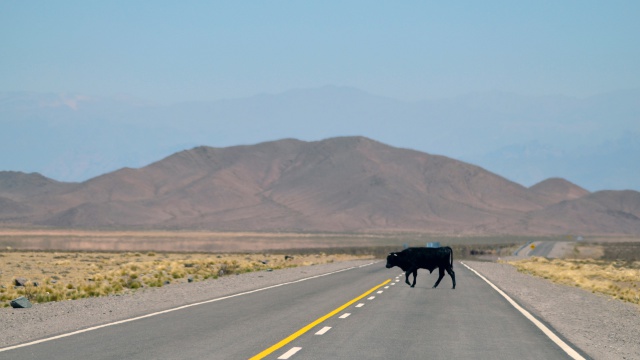
Outside of large cities, road conditions vary from good to poor. Poor-quality roads are often found in areas of Patagonia, such as between El Calafate and El Chalten, Chaco province, and the Andean north west of the country. Major privatisation programmes have resulted in many trunk roads being upgraded, but many other roads remain in poor condition. Because of Argentina's vast distances, overland travel is not recommended for those with time constraints. Roads may be winding and narrow, and often lack protective crash barriers and adequate shoulders; this is the case in the Andean provinces of Jujuy and Salta, which are often used by large transport vehicles that frequently travel too fast If travelling by car, it is not recommended to do so after dark, as livestock roam the roads and many drivers do not use their headlights. Rural roads, made of packed dirt, can become impassable after rain. It is wise to fill one’s petrol tank before setting out on rural roads, since petrol stations are harder to find in isolated areas. In case of emergencies, the Automóvil Club Argentino - ACA (tel: 0800 777 2894) offers breakdown cover and reciprocal benefits for members of motoring organisations in other countries.
All main roads have tolls. Unless otherwise indicated, the speed limits are 40kph (24mph) on city streets, 60kph (37mph) on city avenues, 80kph (49mph) on rural roads, and 120kph (74mph) on highways. On autopistas, the maximum speed permitted is 130kph (80 mph), while the speed limit is 80 kph (50 mph) on one-lane rutas. All passengers and driver are required to wear a seatbelt. It is unlikely that foreign travellers will be stopped for traffic violations or speeding, as such laws are generally not upheld or rigorously enforced. However, if pulled over, be prepared to show identification and proof of ownership or rental agreements for the car. It is possible that the officer will invent a violation in an attempt to extort a small amount of money.
An International Driving Permit is not necessary to drive in the country. If one wishes to obtain a permit, it can be done at the National Transit Authority (Dirección Nacional de Tránsito).
Rail Travel
Most of Argentina's rail network is now unused; rail services are limited and most of the country is unreachable by train. Travel on trains can be rather uncomfortable, but rates tend to be economical when compared to long-distance buses. Since the service is not well maintained, delays are very common and the risk of accidents is considerable.
The main routes out of the capital's three main stations (Retiro, Plaza Constitución, and Once de Septiembre) run to Rosario, Rojas, Santa Rosa, Mar del Plata, Quequen Necochea (via Las Flores), and Bahía Blanca. From Rosario, trains can be taken to Tucuman and Jujuy via Cordoba or via La Banda. Currently, the most used routes are the ones linking Buenos Aires to Bariloche, in the Andes, and Mar del Plata. If travelling during the summer, it is recommended to buy tickets over 10 days in advance; during other seasons, three days in advance is fine.
On 10 May 2024, 90 people were injured after two trains on the San Martín Line collided near Dorrego and Figueroa Alcorta in the Palermo neighbourhood of Buenos Aires.
Public Transport
Ferries and Boats: International ferry services link Buenos Aires with Colonia del Sacramento and Montevideo in Uruguay. These services are safe and run efficiently.
Buses: One of the most popular methods of transportation in Argentina is colectivos or micro buses. Bus lines are differentiated by their distinct colour. The fare is paid directly to the driver or deposited in the automated machines located in the front of the bus. Prepare ahead with exact change to avoid delays. Routes are posted at bus stops along main stretches. As in other major cities, beware of pick-pockets and petty thieves, who usually operate during rush hours. Nonetheless, the bus system can be considered safe.
There is a bus (colectivo) service in Buenos Aires called diferencial (differential) where seats are more comfortable and always available. They follow direct routes and only stop to let passengers off or when there are available seats. Diferencial buses are indicated by a sign on the front of the vehicle. They run less frequently than colectivos, but are more expensive. Stops are every other block, and are marked by small signs noting the number of the bus line. The buses are generally safe and run 24 hours a day. However, the service is irregular at night and should be avoided after 22:00 due to safety concerns.
Over one hundred bus companies run intercity routes in Argentina, so you can reach almost anywhere in the country by bus. However, the standard of the services can vary dramatically, from flat-bed, air-conditioned buses with hostess services, to cramped services without air-conditioning. The better services run on frequently used routes between major cities, especially services departing from Buenos Aires. Inferior services tend to run across the north and in Patagonia. Despite some discomfort, Argentine intercity buses are the best in South America, and are a cheap, safe, if not always rapid, way of travelling.
Metro: Buenos Aires is the only city in the country with an underground system. The metro, or subte as it is commonly called, extends through a good portion of Buenos Aires, with six metro lines specified by a different letter. Although quite fast and efficient for moving within the city, the metro may not be very comfortable and tends to be very hot in the summer. Trains run between 05:30 to 23:30 with variation depending on the day. The metro is quicker and cheaper than colectivos, and is generally safe. However, pickpockets roam the metro.
Taxis: Taxi service is readily available in Argentinean cities: in Buenos Aires alone there are over 32,000 registered taxis. Taxis in Buenos Aires are all clearly marked, and the ‘official taxis’ or 'radio taxi' have a metered service and the taxi firm's name and telephone number visible. Always check that the taxi licence is visibly posted inside the cab, there is a CB radio aerial on the bonnet/hood, and a working meter in the taxi before getting in. These are the most reliable ones, and can be called from any restaurant, hotel or public facility. Ride-share apps such as Uber and Cabify are also a safe alternative.
Another safe option is the remis (call taxi/hire cars) - a type of taxi, which differs from a regular taxi in that the price of the trip is not metered but established in advance. Remis are very common to and from Ezeiza Airport in Buenos Aires. These cabs cannot be hailed from the street; they must be previously arranged and will pick you up at any location in the city. However, many of them are unmarked, so make sure to call for one from an airport, hotel or restaurant. It is not recommended to hail a cab or remis from the street, since 'regular' taxis have an increasing record of robberies and are likely to take a longer route to your destination or attempt other tactics to increase the fare.
Vehicle Hire: Rental cars are available at airports and in cities. Major international firms, including Hertz, Avis, and Budget, operate out of the international airports and are the best option for rentals. Although other local companies may offer better rates, vehicles for hire may be in a poorer condition. If you plan on driving outside of cities or major highways it is recommended to use a four-wheel drive (4x4) vehicle. Always ensure to check around the vehicle before accepting it, as minor damage caused by the previous renter can go unnoticed. It is not necessary to have an International Driving Permit to drive in the country. If one wishes to obtain a permit, it can be done at the National Transit Authority (Dirección Nacional de Tránsito).
Landsinformationen på denna webbplats har översatts med hjälp av maskinöversättning av vår partner. Arbete har utförts för att tillhandahålla en så korrekt översättning som möjligt, dock ska du som läsare ha i åtanke och acceptera att ingen automatisk översättning är perfekt och bör inte heller läsas eller tolkas som så. Landsinformationen är inte avsedd att vara en källa till råd eller handling baserat på det material som presenteras. Ingen garanti antyds eller ges, inga anspråk eller rättsliga åtgärder accepteras.

- {{originalfilename}} x
Närmaste servicekontor
Euro-Center São Paulo
Kan jag boka försäkring till landet?
Våra försäkringar gäller inte vid resa till område som Utrikesdepartementet i sina rekommendationer avråder från att besöka eller vistas i. Vänligen se listan UD avråder för mer information.