

Reseförsäkring Japan
Som turist är det viktigt att komma ihåg att man har ett ansvar för sin egen resa och säkerhet. En av de viktigaste åtgärderna man kan ta på egen hand är att se till att man har en giltig reseförsäkring om man skulle bli sjuk eller skada sig.
Fakta om Japan som resmål
Populära städer och regioner
Japan är känt för sina mångsidiga resmål som erbjuder allt från kulturella upplevelser till natursköna vyer:
- Tokyo: Japans huvudstad och en av världens största städer. Tokyo är känt för sina futuristiska skyskrapor, teknologiska innovationer, shoppingdistrikt som Shibuya och Akihabara, och kulturella platser som Asakusa och Meiji-helgedomen.
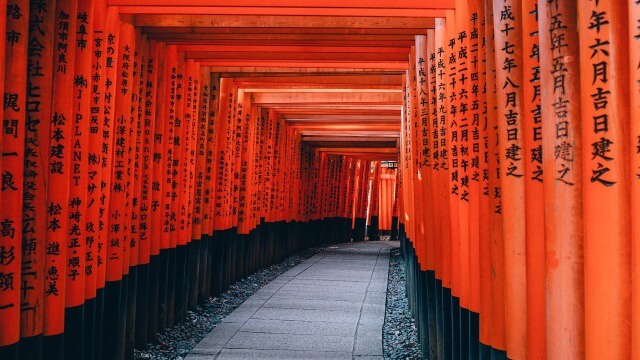
- Kyoto: Den gamla huvudstaden som är känd för sina välbevarade tempel, traditionella tehus och vackra trädgårdar. Kyoto är också hem för den ikoniska Fushimi Inari-helgedomen med dess tusentals röda torii-portar.
- Osaka: En livlig stad känd för sin mat, shopping och nöjesliv. Osaka Castle och Dotonbori-området med sina lysande neonskyltar är två av de mest populära sevärdheterna.
- Hokkaido: Japans nordligaste ö, känd för sin fantastiska natur, orter för vintersport som Niseko, och den årliga snöfestivalen i Sapporo.
- Hiroshima: En stad med en rik historia och en plats för att reflektera och minnas vid fredsparken och museet, som minns offren för atombomben 1945.
Klimat och väder
Japan har ett varierat klimat med fyra tydliga årstider, och som du ser har varje årstid något unikt att erbjuda sina besökare:
- Våren (mars till maj) är känd för körsbärsblomningen (sakura), som är en av de mest populära tiderna att besöka Japan. Temperaturen är mild, vilket gör det till en behaglig årstid att utforska vad städer och natur har att erbjuda.
- Sommaren (juni till augusti) är varm och fuktig, särskilt i södra delarna av landet. Detta är också säsongen för tyfoner, främst i augusti och september. Sommaren är dock en bra tid för att uppleva festivaler och fyrverkerier.
- Hösten (september till november) är årstiden då temperaturen blir svalare och landskapet förvandlas med höstens färger, särskilt i november. Detta är en annan populär tid att besöka Japan.
- Vintern (december till februari) är kall och snörik, särskilt i norra Japan och i bergsområden. Detta är den bästa tiden för vintersport men även för att uppleva traditionella japanska nyårsfiranden.
Säkerhet
Japan är generellt sett ett säkert land med mycket låg kriminalitet. Det är dock viktigt att vara medveten om naturkatastrofer som jordbävningar och tyfoner. Myndigheterna i Japan har ett välutvecklat system för att hantera sådana händelser och besökare bör följa lokala instruktioner och vara förberedda om något skulle inträffa. Hälsovården i Japan är av hög standard, men det kan vara dyrt, så en omfattande reseförsäkring rekommenderas.
Tidsskillnad från Sverige
Japan ligger i tidszonen Japan Standard Time (JST), vilket är UTC+9. Det betyder att Japan ligger 8 timmar före Sverige under svensk vintertid (CET) och 7 timmar före Sverige under svensk sommartid (CEST). Japan har ingen sommartid så tidszonen förblir densamma året runt.
Populär mat och dryck
Japansk mat är världsberömd för sin kvalitet, smakvariation och estetiska presentation. Här är några rätter och drycker du inte bör missa:
- Sushi och sashimi: Färsk rå fisk serverad med ris eller som tunna skivor, ofta med soja, wasabi och inlagd ingefära.
- Ramen: En nudelsoppa med olika smaksättningar som miso, shoyu (soja) eller tonkotsu (fläskbuljong), toppad med kött, grönsaker och ägg.
- Tempura: Friterade grönsaker och skaldjur som serveras med sojasås.
- Okonomiyaki: En japansk pannkaka fylld med olika ingredienser som kött, skaldjur och grönsaker som toppas med sås och majonnäs.
- Sake: Japanskt risvin som serveras varmt eller kallt beroende på sort och tillfälle.
Vanliga fraser på japanska
I Japan talas huvudsakligen japanska men även om engelska är vanligt förekommande i större städer är det bra att kunna några grundläggande fraser på japanska inför resan:
- Hej: こんにちは (Konnichiwa)
- Hejdå: さようなら (Sayōnara)
- Tack: ありがとう (Arigatō)
- Hur mår du?: お元気ですか? (O-genki desu ka?)
- Ja: はい (Hai)
- Nej: いいえ (Iie)
- Skål: 乾杯 (Kanpai)
Reseförsäkring till Japan
Att ha en pålitlig reseförsäkring när du reser till Japan är viktigt överlag, men särskilt om du besöker landet under tyfonsäsongen. Reseskyddet kan skydda dig mot oförutsedda händelser såsom sjukdom, olyckor eller förlorat bagage. Eftersom sjukvårdskostnaderna kan vara höga i Japan är det särskilt viktigt att försäkringen täcker medicinska utgifter och eventuell evakuering vid nödsituationer.
Viktiga restips
- Betalningar: Även om Japan är ett högteknologiskt land är kontanter fortfarande mycket vanligt, särskilt i mindre butiker och restauranger. Det är bra att ha med sig japanska yen i kontanter även om kreditkort accepteras på de flesta hotell och större restauranger.
- Kulturella normer och seder: I Japan är det viktigt att visa respekt, vilket inkluderar att buga när man hälsar och att ta av sig skorna innan man går in i någons hem eller vissa traditionella byggnader. Vid måltider är det vanligt att säga "itadakimasu" före man börjar äta och "gochisousama deshita" efteråt som ett sätt att visa tacksamhet. Japan är känt för sin punktlighet och strikta regler i kollektivtrafiken. Var noga med att följa lokala seder och vara i tid till avtalade möten och evenemang.
Översikt
Capital: Tokyo (pop. 37.194 million)
Population: 123,103,479 (2025 est.)
Other Urban Areas: Osaka (pop. 19.013 million); Nagoya (pop. 9.569 million); Kitakyushu Fukuoka (pop. 5.490 million); Shizuoka Hamamatsu (pop. 2.937 million); Sapporo (pop. 2.666 million)
Religions: Shintoism, Buddhism, Christianity
Languages: Japanese
Time Zone: UTC+9
Driving side: Left
Calling code: +81
Electrical plug(s): Type A and Type B
Pengar
The local currency in Japan is Yen (JPY). As of 6 October 2026 100 JPY is equal to 0.63 USD.
Currency exchange can be done at airports, banks and exchange offices. It is recommended to avoid currency exchange at the airport since the rates are awful and the fees are high.
Travellers should be prepared to use either cash or credit or debit card to make payments. Credit cards are widely accepted. ATMs are available in most places.
Visa, Mastercard and JCB are the most widely accepted cards in Japan
Tipping is not expected by the majority of service workers.
El
The power supply in Japan is reliable. Electricity operates on 110V at 50Hz or on 110V at 60Hz using plug type(s) A and B.
Pass
Most travellers will need a passport to enter Japan. The passport must be valid for the duration of the stay and have one blank page.
Visum
Visa-free entry is available for certain travellers who qualify based on nationality and purpose of travel. Travellers may qualify for a visa waiver, however this requires the completion of a security check or travel authorisation prior to departure. All other travellers will need to obtain a visa from the nearest embassy or consulate or apply online (e-visa) prior to travel.
Entry visa requirements vary based on nationality, purpose of travel and other factors. Individual travellers are responsible for ensuring that they comply with all visa requirements, which should be confirmed with authorities at their destination prior to travel.
Visa Free Travel
Visa Free travel to Japan (15 days): Nationals of Indonesia and Thailand can enter Japan without a visa for up to 15 days. Check here for further information on the eligibility for visa-free entry.
Visa Free travel to Japan (30 days): Nationals of select countries can enter Japan without a visa for up to 30 days. Check here for further information on the eligibility for visa-free entry.
These travellers must first register for an ICAO-compliant ePassport to the diplomatic missions of Japan (the embassy, consulates-general, or the consulate).
Visa Free travel to Japan (90 days): Foreign nationals from select countries can enter Japan without a visa for up to 90 days. Check here for further information on the eligibility for visa-free entry.
Nationals of Türkiye, Lesotho and Barbados must first obtain an ICAO-compliant Machine-Readable Passport; nationals of Brazil, the United Arab Emirates, Thailand, Serbia, Malaysia and Panama must obtain an ICAO-compliant ePassport.
Passport holders from Mexico, Germany, Austria, Ireland, the United Kingdom (UK), Liechtenstein and Switzerland can apply for an extension and stay in Japan for up to six months.
e-Visas
E-visa (Chinese nationals): Nationals of China residing in China may apply for a single-entry short-term electronic visa valid for a stay of up to 15 or 30 days.
Visas
Short-stay visa: Nationals of select countries and those who are not eligible to visit Japan visa-free may apply for short-term stay visas to enter the country. Generally, travellers are permitted to stay for up to 90 days, but different permitted stay periods and visa validity apply to respective nationalities.
Lokal resor
Overview
Japan's train and bus networks provide safe and reliable transport throughout the country. Rural areas are even safer than cities. The greatest danger to foreign nationals is that Japan's reputation for safety may lull visitors into a false sense of security, causing them to neglect to take sensible everyday precautions. While major urban centres cater well to English speakers, few Japanese speak English in rural areas and many signposts are not written in Latin script.
Travel Safety
Air Travel
Japan is served by several international airports. Narita Airport (NRT/RJAA) is Japan's main international gateway and is located around 70km (44 miles) northeast of Tokyo. Tokyo International Airport/Haneda Airport (HND/RJTT), located in Tokyo's Ota City around 14km (9 miles) south of Tokyo Station, primarily handles domestic traffic but increasingly accepts larger numbers of international flights. Kansai International (KIX/RJBB) in Osaka prefecture is the main international airport for much of western Japan. Fukuoka Airport (FUK/RJFF) on the southern island of Kyushu also operates many international routes. Safety is very good at all of Japan's international airports, and air traffic control systems use the most modern technology. Security screening is also of a high standard and there have been no serious security breaches at the main international airports in recent years. Random baggage checks are regularly carried out. Customs processing is straightforward and efficient. Incoming international passengers are divided into two queues, one for Japanese citizens and foreign national residents with an alien registration card, and the other for non-resident foreign nationals.
Narita, Haneda, Fukuoka and Kansai airports are directly linked to their respective cities by train and bus. Narita Express trains run from Narita via the Narita and Sobu train lines to Tokyo Station, while multiple Keisei trains connect Narita to different parts of Tokyo. Taxis are available at all airports, but the journey to the city (especially from Narita to Tokyo) can be quite long and the fares can be extremely high. Having a car pick you up or opting for public transport is advisable. The main international airports serving Osaka and Tokyo are quite far from the cities, so allow for transfer times of two hours or longer. Other airports, such as those in Sapporo, are more easily accessible.
The country's flag carrier, Japan Airlines (JAL), is based at Haneda Airport and has an excellent safety record, with no recent history of fatal crashes.
Dozens of regional airports around the country mostly serve internal flights but some, such as Chūbu Centrair International Airport (NGO/RJGG) serving Nagoya in Aichi prefecture and New Chitose Airport (CTS/RJCC) serving Sapporo in Hokkaido prefecture, offer international flights, including those to and from South Korea and China. Domestic flights in Japan are quite expensive if not purchased in advance. JAL and ANA dominate most routes and there is limited domestic competition. If purchasing in advance, special deals and discounts are possible.
Borders and Entry
Entry measures: Travellers may use the new Visit Japan Web for Fast Track registration, as well as for immigration and customs procedures.
Health-related surveillance measures: Authorities implemented Ebola surveillance measures at the country’s entry ports, effective until further notice, to prevent the entry of the disease.
Identification
Most travellers will need a passport to enter Japan. The passport must be valid for the duration of the stay and have one blank page.
Travellers with passports where gender is indicated as "neutral" may be denied entry. Contact the nearest embassy, high commission or consulate to confirm if entry is allowed with passports where gender is indicated as "neutral". The country's overall social acceptance of LGBTQ people is good.
Required Documents
Entry requirement: All inbound travellers must complete and submit a questionnaire before departure to be allowed entry. Authorities recommend travellers submit the questionnaire through the Visit Japan Web online registration. Document link: https://services.digital.go.jp/en/visit-japan-web/
Road Travel
Driving in Japan is very safe compared with other Asian countries. Japanese drivers are courteous, and the roads are well-maintained. All traffic moves on the left. Most visitors will require an International Driving Permit, issued in their home country in advance, to drive in Japan and drivers must be 18 years of age or older. Speed limits are strictly enforced by speed cameras and radar detection technology. The drunk driving limit is 0.3 milligrams of alcohol per millilitre of blood and is strictly enforced. Driving conditions can be treacherous in wet or snowy conditions.
Narrow, winding roads and icy weather mean that drivers should use extra caution in the winter months. When travelling long distances, drivers must use a reliable vehicle, carry an up-to-date map or GPS, be equipped with water, appropriate clothing, a telephone and an emergency kit and plan their route prior to departure.
Rail Travel
An extensive and reliable rail network covers nearly the entire length of Japan. The Bullet Train (Shinkansen) runs the entire length of the Pacific coast of Honshu Island. The Shinkansen is safe, clean, reliable and extremely fast. Ticket prices for trains (especially for the Shinkansen) are considerably more expensive than the corresponding bus journey, but journeys take a fraction of the time. Reserved and non-reserved carriages are available on all trains. Conventional rail services also connect most urban areas, and these are reliable and efficient.
The Sea of Japan coast is covered by a conventional train network. Although not as fast as the Shinkansen, it is similarly efficient and safe. The only significant risk to travellers on the Japanese rail network is petty crime. Journeys between the east and west can often take a considerable amount of time due to the obstacles presented by Honshu's mountainous interior.
The train is considered among the safest in the world and only had a single fatal incident in over 50 years of service when a passenger burned himself to death on a Shinkansen Nozomi train from Tokyo to Osaka, leaving another passenger dead and injuring 20 others. Such incidents are extremely rare.
Foreign nationals who plan to use the train network are advised to look into the Japan Railways (JR) Rail Pass. This pass is only available to foreign nationals and offers substantial savings. It can only be purchased outside of Japan; details can be found at a local Japanese embassy or consulate.
Public Transport
Ferries and Boats: Regular ferry services link Japan's islands. Boats are generally modern, efficient, and well-equipped with safety features. There are no significant risks associated with domestic ferry travel.
Buses: Bus transport is highly developed and efficient in Japan. Rural and intercity routes are served by an extensive network of buses. Japan is a very long country and bus journeys between some major urban areas; for example, Tokyo to Fukuoka can take as long as eight hours. Many such journeys can be taken by overnight bus. Vehicles used are modern and safe.
Metro: Most large cities, including Tokyo, Osaka, Fukuoka, Kobe, Sapporo and Yokohama, have subway systems that are smoothly connected with other municipal and regional transit systems. Tokyo has two subway systems: one run by the Tokyo Metro with nine lines and the other operated by the Tokyo Transportation Bureau (Toei), with four lines. Outlying areas are served by several private railroad companies, whose lines intersect at major stations with the subway system.
Taxis: Licensed taxi companies operate in most major urban areas. All Japanese taxis carry fixed meters, and unlicensed operators are practically unheard of. Taxis can be hailed on the street by raising your arm, and taxi ranks can usually be found near train stations.
Ride-hailing services, namely Uber and Go, are viable and convenient alternatives to traditional taxis.
Trams: Multiple cities have tram networks that complement the bus systems, including Hiroshima, Matsuyama, Nagasaki, Tokyo and Toyohashi. Trams are generally safe and accidents are rare.
Vehicle Hire: Cars can be rented throughout the country, even in smaller urban areas. Rental vehicles are predominantly recent models and are well-maintained. To rent, you must have an International Driving Permit, which must be obtained from your home country's automobile association before leaving. However, the International Driving Permits of a few countries, including Belgium, France, Germany, Monaco, Switzerland and Taiwan are not valid. Drivers from these countries can use their regular licences, provided they acquire an official Japanese translation of their driving licences from their respective country's embassy or consulate in Japan.
The cost of driving a car in Japan goes beyond the rental price. Fuel can be expensive and highways operate on a toll system, which can also prove costly. In most cases, drivers will have no choice but to take the toll highways due to the slow traffic on regular roads.
Movement Control Orders
Due to the risk of exposure to radioactive materials, evacuation orders (no-go zones) remain active for several areas around the Fukushima Dai-ichi nuclear power plant, specifically parts of Katsurao, Namie, Futaba, Okuma and Tomioka towns, Iitate village, and Minamisouma, in Fukushima prefecture. The evacuation orders were first triggered in 2011 when the earthquake and tsunami damaged the nuclear power plant. Further details on evacuation areas can be found on Fukushima prefecture's website and here.
Limited entry is only permitted by local authorities to public agencies, affected residents, or workers employed in reconstruction projects and only to four-wheel vehicles on specific routes; vehicles inside the restricted area should not stop along the road.
Landsinformationen på denna webbplats har översatts med hjälp av maskinöversättning av vår partner. Arbete har utförts för att tillhandahålla en så korrekt översättning som möjligt, dock ska du som läsare ha i åtanke och acceptera att ingen automatisk översättning är perfekt och bör inte heller läsas eller tolkas som så. Landsinformationen är inte avsedd att vara en källa till råd eller handling baserat på det material som presenteras. Ingen garanti antyds eller ges, inga anspråk eller rättsliga åtgärder accepteras.

- {{originalfilename}} x
Närmaste servicekontor
Euro-Center Sydney
Kan jag boka försäkring till landet?
Våra försäkringar gäller inte vid resa till område som Utrikesdepartementet i sina rekommendationer avråder från att besöka eller vistas i. Vänligen se listan UD avråder för mer information.