

Reseförsäkring Kambodja
Som turist är det viktigt att komma ihåg att man har ett ansvar för sin egen resa och säkerhet. En av de viktigaste åtgärderna man kan ta på egen hand är att se till att man har en giltig reseförsäkring om man skulle bli sjuk eller skada sig.
Kambodja har landsgränser mot Thailand, Laos och Vietnam med kustremsa mot Thailandsviken. Med sitt läge i Sydöstasien råder här varma temperaturer året om, men bäst att besöka landet är det under torrperioden november till april. Klimatet skapar ett grönt och lummigt land med frodiga risplantager och regnskogar. Perfekt att utforska för dig som vill uppleva exotisk växtlighet med djur i dess rätta natur.
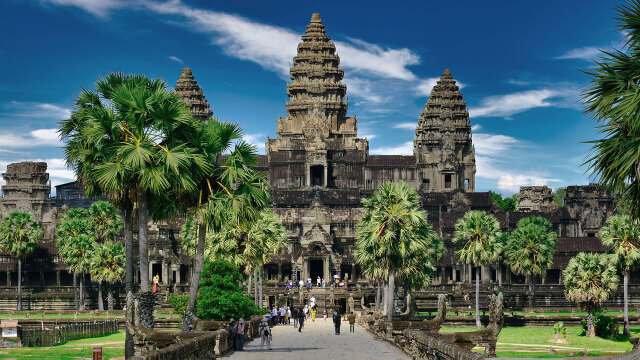
Men främst är Kambodja känt för sina många historiska tempel, som med imponerande detaljrikedom och arkitektur har imponerat människor i årtusenden. Det är i den forna kungastaden Angkor som man hittar över 70 stora tempel, alla lika häpnadsväckande. Några av de tempel som är populära resmål är Angkor Vat, Ta Phrom och Bayon. Men också mindre kända tempel som Preah Khan och Bakong. Var man än vänder sig i detta historiska område kan man vara säker på att ha en vacker vy.
I Kambodjas huvudstad, Phnom Penh, kan man också ta del av fantastisk arkitektur. Bland annat genom ett besök till Royal Palace. Väl värt ett besök är också de många marknader som finns i staden, där lokala hantverk och frukter kan köpas. Vill du lära dig mer om det kambodjanska köket? Då kan vi rekommendera att ta del av matlagningskurser. En aktivitet som du kan föra med dig hem för att återuppleva känslan.
Inför din resa till Kambodja bör du hålla koll på väderläget, då landet drabbas av monsunsäsong varje år. Sjukvården håller inte samma standard som i Sverige, varken i de mindre byarna eller större turistområdena. När du planerar din resa bör du därför se till att du har en reseförsäkring med dig till Kambodja, om något oväntat skulle inträffa.
Översikt
Capital: Phnom Penh (pop. 2.281 million)
Population: 17,847,982 (2025 est.)
Religions: Buddhist, Muslim, Christian, other
Languages: Khmer, Chinese, Vietnamese, other minority languages
Time Zone: UTC+7
Driving side: Right
Calling code: +855
Electrical plug(s): Type A, Type C and Type G
Pengar
The local currency in Cambodia is Riels (KHR). As of 6 October 2026 100 KHR is equal to 0.02 USD. In addition to the local currency, THB and USD may be accepted for payment in some places.
Currency exchange can be done at banks and exchange offices.
Travellers should be prepared to use credit or debit card payments in urban areas and cash in rural areas. Credit cards are accepted in some establishments but cash remains the preferred payment method. Credit cards are accepted in upscale and/or tourist areas only. ATMs are only available in urban and/or tourist areas.
In some parts of the country smaller transactions can be paid for in either the US Dollar or Thai baht (especially in Thai border areas). However, this is not guaranteed so personnel should consider it as a last resort. Banking hours are generally Monday to Friday between 0800-1500 local time. Some banks are open on Saturdays.
A tip of 10% is appropriate at restaurants. If you are staying in a hotel, give the bellman around $1 (USD) per bag and housekeeping $1 (USD) per day. Taxi drivers do not expect tips.
El
The power supply in Cambodia is not reliable. Electricity operates on 230V at 50Hz using plug type(s) A, C and G. The power supply is frequently disrupted outside of Phnom Penh. Indeed in many areas electricity is only supplied in the evening. It is advisable to bring with a UPS unit to provide short-term battery power in the event of a power failure to give you enough time to shut down any computer equipment. If basing outside of the capital for an extended period of time you may want to consider using your own electricity generator.
Pass
Most travellers will need a passport to enter Cambodia. The passport must be valid for at least six months after the date of arrival and have one blank page.
Visum
Visa-free entry is available for certain travellers who qualify based on nationality and purpose of travel. All other travellers will need to obtain a visa from the nearest embassy or consulate or apply online (e-visa) prior to travel.
Entry visa requirements vary based on nationality, purpose of travel and other factors. Individual travellers are responsible for ensuring that they comply with all visa requirements, which should be confirmed with authorities at their destination prior to travel.
Visa Free Travel
Visa-free travel to Cambodia (14 days): Foreign nationals of select countries may enter Cambodia without a visa for up to 14 days.
Visa-free entry for Chinese Nationals (14 days): Nationals of China, Hong Kong and Macau passport holders are allowed to enter Cambodia without a visa for up to 14 days.
Visa-free travel to Cambodia (15 days): Foreign nationals of Seychelles may enter Cambodia without a visa for up to 15 days.
Visa-free travel to Cambodia (30 days): Foreign nationals of select countries may enter Cambodia without a visa for up to 30 days.
e-Visas
Tourist eVisa or VoA: Most foreign nationals intending to stay in Cambodia for tourism purposes must obtain a tourist visa valid for up to 30 days. Tourist visas may be obtained before or upon arrival (VoA) or online (eVisa). Tourist visas can be extended for one month.
Tourist Visa-on-arrival schemes are only available in some airports. Authorities do not specify which foreign nationals are eligible for the tourist visa-on-arrival. Travellers are advised to consult the embassy or consular services prior to departure.
Lokal resor
Overview
Public transport options in Cambodia range from buses and taxis to moto-taxis and boats. Taxis are the preferred form of transport for intra-district travel due to their higher level of comfort. Buses, including airport shuttle buses, are often congested and uncomfortable, and vehicles are poorly maintained. While there are numerous car rental companies, roads are poorly maintained outside of major cities like Phnom Penh making self-drive dangerous. Ferries are susceptible to accidents due to overcrowding while domestic flights are the safest option for inter-city travel.
Travel Safety
Air Travel
Foreign visitors flying into Cambodia will most likely enter through Techo International Airport (KTI/VDTI), Siem Reap International Airport (REP/VDSR) or Sihanouk International Airport (KOS/VDSV). Cambodia has at least 14 abandoned airports. Air travel is safe compared to other methods of transport.
On 8 September 2025, the opening of the new Techo International Airport replaced Phnom Penh International Airport (PNH/VDPP) as the country's main airport serving Phnom Penh. Phnom Penh Airport is currently closed to the public and operates as a military airbase. Techo Airport is located around 30 kilometres south of Phnom Penh in Kandal province. All airlines that previously served Phnom Penh Airport now serve Techo Airport.
Borders and Entry
Border closure: Thai authorities closed all border crossings with Cambodia amid ongoing clashes between Cambodian and Thai soldiers that erupted in the area of Prasat Ta Muen Thom in Thailand's Surin province, close to the border with Cambodia's Oddar Meanchey province, and spread to other areas. For certain crossings, Thai and Cambodian nationals could use the crossing to return to their home country. Authorities fully closed the Hat Lek border.
Health-related surveillance measures:
- Authorities implemented Ebola surveillance measures at the country’s entry points, effective until further notice, to prevent the entry of the disease.
Identification
Most travellers will need a passport to enter Cambodia. The passport must be valid for at least six months after the date of arrival and have one blank page.
Travellers with passports where gender is indicated as "neutral" may be denied entry. Contact the nearest embassy, high commission or consulate to confirm if entry is allowed with passports where gender is indicated as "neutral". The country's laws on LGBTQ people are conservative, and overall social acceptance is low. Lesbian, gay, bisexual, transgender and queer travellers in Cambodia might face legal and social difficulties.
Required Documents
Travel (PLF): Officials require all inbound travellers to complete the Cambodia e-Arrival (CeA) Card, a new e-immigration platform replacing the paper-based method as part of measures to streamline the entry process. The CeA Card must be filled out within seven days before arrival. Travellers will be required to upload a photo and their passport information and fill out health and customs declaration forms on the CeA platform. In addition to the iOS and Android applications, the CeA can also be filled out on its website. Travellers unable to complete the CeA before arrival will be provided a tablet upon arrival to complete the registration.
Entry requirement: All inbound foreign nationals must register using the Foreigners Present in Cambodia System (FPCS) mobile application. The app is used to record arrival and exit data. Travellers are recommended to complete registration prior to arrival. The app can be downloaded on Android or iOS devices.
Road Travel
Traffic in Cambodia moves on the right side of the road. Road conditions in major cities, including Phnom Penh and Siem Reap, are adequate, while roads in rural areas are often in poor condition. Traffic laws are frequently ignored. The risk of traffic accidents is high, especially while travelling at night. Renting a vehicle and driving on your own is not recommended due to the poor quality of roads and dangerous driving conditions outside major cities. Cambodia lacks a coordinated emergency response system for victims of traffic accidents outside of Phnom Penh and Siem Reap, so particular care should be exercised when travelling by road. The urban speed limit ranges from 30-40kph (19-25 mph) and the rural speed limit ranges from 40-60kph (25-37 mph). Both speed limits are routinely ignored and poorly enforced. Road travel in Cambodia can be very dusty, especially on unpaved roads.
Rail Travel
At present, there is a limited train network operating on two lines in Cambodia: a 14-hour journey from Phnom Penh to Battambang on alternating days and a 6.5-hour journey from Phnom Penh to Sihanoukville via Kampot, operating on weekends. Despite recent upgrades and refurbishments, trains and tracks are not adequately maintained in Cambodia. Train cars are very basic with some passengers bringing their own hammocks for seating. Train travel is also very slow with frequent delays and can be crowded and shared with livestock. Technical difficulties are common, causing delays and accidents. While uncommon, there have also been sporadic reports of robbery and banditry along the train route.
Public Transport
Ferries and Boats: Travel by boat is a common way to get to and from Siem Reap and Phnom Penh. Visitors can also cross into Cambodia from Vietnam at the Chau Doc border crossing. Travelling by boat carries a high risk. Boats are commonly overcrowded and passengers often sit on the roof. There have been reports of foreign nationals falling off the top of boats due to overcrowding and high speeds. Vessels are rarely equipped with adequate safety equipment and maintenance standards are poor. Sinking accidents occur periodically and can result in casualties. If you expect to be taking a ferry ride, it is advisable to buy your own buoyancy aid for use in an emergency. Avoid remaining below deck.
Buses: Public bus services are limited in Cambodia. Some services are actually operated using trucks, with passengers either riding in the cab or the bed of the truck. Travel in this manner is ill-advised due to overcrowding, lack of seat belts and risk of injury or accident.
Most guesthouses and hotels have buses that function as shuttles between major urban destinations, borders and the hotel site. These buses tend to be poorly maintained, cramped, and lacking air conditioning. Buses affiliated with several guesthouses and hotels will likely make a large number of stops along their route to accommodate visitors staying at different places.
Motorcycle Taxis: Moto-taxis, or motodop, are an extremely common form of transport in Cambodia. Prices should be agreed on before getting on the motorcycle. Caution should be exercised when using a moto-taxi and you should wear a helmet at all times. Traffic in Cambodia can be very chaotic and accidents involving moto-taxis are common. There have been reports of robbery and assault by moto-taxi drivers, particularly at night, so moto-taxis should be used in the daylight hours only.
Taxis: In Cambodia, metered taxi services are offered. Taxis can also be booked through ride-sharing apps, namely Grab and PassApp. Taxis are generally the most reliable means of transport.
Vehicle Hire: It is recommended that foreign nationals do not self-drive vehicles due to poor road safety and traffic conditions. Major car rental companies offer services in Phnom Penh and several other locations in the country.
Landsinformationen på denna webbplats har översatts med hjälp av maskinöversättning av vår partner. Arbete har utförts för att tillhandahålla en så korrekt översättning som möjligt, dock ska du som läsare ha i åtanke och acceptera att ingen automatisk översättning är perfekt och bör inte heller läsas eller tolkas som så. Landsinformationen är inte avsedd att vara en källa till råd eller handling baserat på det material som presenteras. Ingen garanti antyds eller ges, inga anspråk eller rättsliga åtgärder accepteras.

- {{originalfilename}} x
Närmaste servicekontor
Euro-Center Bangkok
Kan jag boka försäkring till landet?
Våra försäkringar gäller inte vid resa till område som Utrikesdepartementet i sina rekommendationer avråder från att besöka eller vistas i. Vänligen se listan UD avråder för mer information.