
Reseförsäkring Nepal
Som turist är det viktigt att komma ihåg att man har ett ansvar för sin egen resa och säkerhet. En av de viktigaste åtgärderna man kan ta på egen hand är att se till att man har en giltig reseförsäkring om man skulle bli sjuk eller skada sig.
Många förknippar säkert Nepal med världens högsta berg – Mount Everest – som delvis ligger i landet. Det är platsen dit många våghalsar och naturälskare tar sig för att både testa sina gränser och uppleva häpnadsväckande miljöer. Vare sig du väljer att sikta mot toppen, eller föredrar vandring på lägre höjder, är det en plats som ger minnen för livet. Men Nepal är också platsen för många religiösa och vackra tempel, safarimöjligheter där du kan möta noshörningar, elefanter och tigrar, samt hitta lugna små byar att bara njuta av tillvaron i.
I Nepals huvudstad Katmandu kan du mixa shopping och färgglada marknader med landmärken från medeltiden och heliga monument. Är du intresserad av att bocka av sevärdheter listade på UNESCO:s världsarvslista? Då hittar du tio av dessa i Nepal, fördelat på såväl nationalparker som religiösa monument och platser:
- Sagarmatha National Park
- Chitwan National Park
- Changu Narayan Temple
- Bhaktapur Durbar Square
- Boudhanath Stupa
- Kathmandu Durbar Square
- Lumbini - The birthplace of Lord Buddha
- Pashupatinath Temple
- Patan Durbar Square
- Swoyambhunath Stupa
Inför din resa till Nepal rekommenderar vi att du ser över din reseförsäkring och säkerställer att du har ett skydd som möter dina behov. Särskilt viktigt är det om du planerar att ge dig upp på hög höjd. Bra att ha med sig är att sjukvården i landet inte håller samma standard som i Sverige. Det är alltid bra att kolla upp var närmsta sjukhus ligger på den ort du kommer befinna dig.
Översikt
Capital: Kathmandu (pop. 1.571 million)
Population: 29,618,118 (2025 est.)
Religions: Hindu 81.3%, Buddhist 9%, Muslim 4.4%, Kirant 3.1%, Christian 1.4%
Languages: Nepali, Maithali, Bhojpuri, Tharu, Tamang, Newar, Bajjika, Magar, Doteli, Urdu, Avadhi, Limbu, Gurung, Baitadeli; note: 123 languages reported as mother tongue
Time Zone: UTC+5.75
Driving side: Left
Calling code: +977
Electrical plug(s): Type C, Type D and Type M
Pengar
The local currency in Nepal is Nepalese rupees (NPR). As of 6 October 2026 100 NPR is equal to 0.65 USD. In addition to the local currency, INR may be accepted for payment in some places.
Currency exchange can be done at banks and exchange offices.
Travellers should be prepared to use credit or debit card payments in urban areas and cash in rural areas. Credit cards are accepted in some establishments but cash remains the preferred payment method. Credit cards are accepted in upscale and/or tourist areas only. ATMs are only available in urban and/or tourist areas.
The receipt from any money exchange transaction as this will be required by travellers at the airport to convert money back to the original currency before leaving Nepal. Travellers should note that export of national and Indian currency from the country is prohibited, except for Nepalese and Indian nationals.
At restaurants, if a service charge has not been included, 10% of the bill is an acceptable tip. Porters may be tipped $2-4 (USD) per day, guides $3-5 (USD) per day.
El
The power supply in Nepal is less than reliable. Electricity operates on 230V at 50Hz using plug type(s) C, D and M. Electricity supply within the country can be volatile and prone to sudden power outages. Travellers in possession of laptops and mobile phones are thus advised to procure surge protection equipment.
Pass
Most travellers will need a passport to enter Nepal. The passport must be valid for at least six months after the date of arrival and have one blank page.
Visum
Visa-free entry is available for certain travellers who qualify based on nationality and purpose of travel. Travellers may qualify for a visa waiver, however this requires the completion of a security check or travel authorisation prior to departure. A visa on arrival scheme is in place for select travellers, but often depends on nationality, purpose of travel and port of entry. All other travellers will need to obtain a visa from the nearest embassy or consulate or apply online (e-visa) prior to travel.
Entry visa requirements vary based on nationality, purpose of travel and other factors. Individual travellers are responsible for ensuring that they comply with all visa requirements, which should be confirmed with authorities at their destination prior to travel.
Visa Free Travel
Visa-free travel to Nepal: Nationals of India with valid passports or voter IDs may enter Nepal visa-free. Authorities did not specify the permitted stay period for these travellers.
Visa Waivers
SAARC Visa Exemption Scheme: Under the South Asian Association for Regional Cooperation (SAARC) visa exemption scheme, eligible businessmen, journalists and government officials may travel visa-free to member states of SAARC. Eligible nationals will be issued an SAARC Visa Exemption Sticker or a special travel document.
From 23 April 2025, the authorities of India and Pakistan suspended the SAARC visa waiver scheme for Indian and Pakistani nationals.
Visas on Arrival
Visa on arrival - Electronic Travel Authorization (ETA): Most foreign nationals may apply for a visa upon arrival to enter Nepal; the Tourist visa is the only visa available on arrival. Applicants for a visa-on-arrival must fill in the Online 'Tourist Visa' form prior to their arrival or fill out the form upon arrival at the airport of entry.
Travellers with a Tourist visa may stay for up to 90 days, provided they pay the 90-day permitted stay period option; travellers may also choose the 15-day or 30-day stay visa.
To expedite entry processes, travellers may apply for an Electronic Travel Authorisation (ETA) before arrival. When a traveller completes an ETA before arrival, the visa-on-arrival issuance process at the immigration desk will be expedited.
Visa-on-arrival services are available at Tribhuvan International Airport (KTM/VNKT) and certain land border checkpoints.
Visas
Entry visa: Foreign nationals from select countries must apply for a visa prior to their arrival at their local diplomatic missions (embassies/consulates).
Travellers with a Tourist visa may stay for up to 90 days; travellers may also choose the 15-day stay visa or the 30-day stay visa.
Lokal resor
Overview
Public transport options available in Nepal include buses, taxis and bicycle rickshaws in urban areas, while in more remote areas it is mostly buses, taxis and motorcycles. Trains are very limited. The safest option for travel between cities is domestic flights. Road conditions are poor, and the terrain is dangerous, hence self-drive options are unsafe. Inter-city buses, trains and bicycle rickshaws are poorly maintained and frequently involved in road accidents due to poor driving standards.
Travel Safety
Air Travel
As of 13 September, flights had been suspended at Taplejung Airport (TPJ/VNTJ), Koshi province, since 5 June, due to persistent monsoon rain, fog and mist
Tribhuvan International Airport (TIA/KNKT) is Nepal’s main airport and is located in the capital city of Kathmandu, 5.5 km (3.4 miles) east of central Kathmandu. The airport serves both domestic and international routes, with Air India, Qatar Airways, IndiGo and Air Arabia serving international routes, while Yeti Airlines and Buddha Air serve domestic routes.
Public buses operated by Sajha Yatayat connect the airport to the city centre (route 5), and the bus stop is located between the international Terminal and the roundabout. Alternatively, there are Airport Shuttle Buses operated by the Nepal Tourism Board. Licensed taxis are available at the airport.
All carriers certified by the regulatory oversight authorities of Nepal are banned from operating flights to Europe due to a lack of conformity with the necessary technical elements and requirements prescribed by the applicable international safety standards. The airlines include Altitude Air, Buddha Air, Fishtail Air, Summit Air, Heli Everest, Himalaya Airlines, Kailash Helicopter and Air Dynasty Heli.
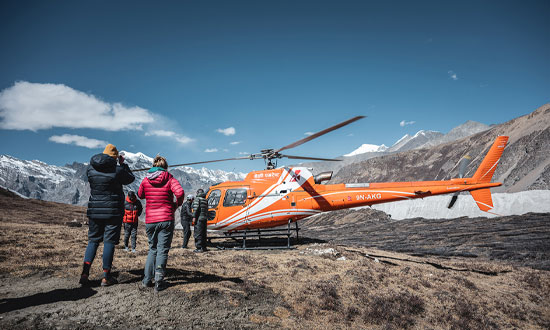
The Civil Aviation Authority of Nepal may restrict the operation of helicopter flights; a permit may be required for operations, including rescue flights.
Leisure-related helicopter services may be restricted or suspended in Koshi province’s Sagarmatha National Park due to environmental concerns.
Borders and Entry
Border closures:
-
Since early January, authorities closed the Tatopani-Zhangmu border crossing between Nepal’s Tatopani in Bagmati province and China’s Xizang (Tibet) autonomous region until further notice due to a forest fire in China’s Nyalam and Zhangmu (Khasa) areas. Chinese officials continue to close the crossing as their customs system is inoperable due to damage caused by the fire.
-
Authorities closed the Rasuwagadhi border crossing between Nepal's Rasuwa Fort (Rasuwagadhi) in Bagmati province and China’s Xizang (Tibet) autonomous region until further notice due to a flood in July 2025.
Health measures:
- Authorities are enforcing Ebola surveillance measures for travellers from disease-hit countries at Kathmandu’s Tribhuvan International Airport (KTM/VNKT), until further notice, to prevent the entry of the Ebola virus.
Identification
Most travellers will need a passport to enter Nepal. The passport must be valid for at least six months after the date of arrival and have one blank page.
Travellers are allowed entry with passports where gender is indicated as "neutral". The country's overall social acceptance of LGBTQ people is good.
Advice: Your passport should be valid for at least 6 months when you submit your application for a visa
Road Travel
Traffic moves on the right side of the road. The main roads in the capital and major cities like Kathmandu are fairly well-maintained, but the traffic is chaotic, especially with drivers and pedestrians frequently disobeying traffic rules. Traffic jams tend to get worse during afternoons and evenings. Public buses tend to stop wherever they see passengers, adding to the chaos.
Processions, sit-in demonstrations and blockades on main roads are frequent occurrences. In southern Nepal, protesters often block highways, sometimes for days. Protesters have also blocked international border crossings, as was witnessed previously at the Birgunj Station. You should not venture out in a car or bus during strikes or protests, as mobs have even been known to attack ambulances.
Nepal has a very high accident rate due to rash driving and the use of old vehicles. Street signals are often missing or ignored. Jaywalking is common, and when there are traffic jams, motorcyclists often choose to ride on the pavement. Drunk driving is also a common occurrence since Nepal has no stiff penalty for driving under the influence, even if there’s a 0 mg/L alcohol tolerance. You will also find gaping manholes with the covers stolen. Many streets are dark and unlit at night.
Nepal's roads are often impacted by the country's environment; the Mahendra Highway and the Kathmandu−Hetauda Road, known as Tribhuvan Highway, have often been damaged by landslides caused by heavy rainfall in the region. Deadly road accidents are also quite common; the Butwal−Palpa Road has a high accident rate, as does the Atariya−Dadheldura in the far west. Check the status of intended overland travel routes with local authorities prior to departure.
Link roads to and from Siraha, Saptari, Rautahat, Rupendehi, Kapilavastu and Dhanusha, particularly the Kodari Highway (also known as the Araniko Highway), which goes north towards Tibet, are also risky due to steep slopes and numerous hairpin turns; travel on these roads should be avoided after 18:00 local time.
Rail Travel
Nepal has a passenger train service only in the Dhanusha district in the south, where a short track of 52km (32 miles) runs from Janakpur town to Jaynagar on the Indian border. Tickets are purchased on a first-come, first-served basis at the station, but digital bookings can be made on the Nepal Railways app. The railway is poorly maintained. Although there have been no major safety incidents, it remains of very little practical use.
Public Transport
Safa Tempo/Kathmandu Tuktuk: This is a tiny, gas-driven vehicle that can carry 11 to 12 people and is found mostly in Kathmandu and Lalitpur. The cheapest mode of transport, it is advisable to use tuk-tuks only if there is no other form of transport covering your route for short distances within the city, as they are not sturdy and particularly vulnerable to potholes on poorly maintained roads and aggressive drivers of larger vehicles. When you want to get down, you have to bang on the roof. Tickets are usually not issued against fares paid on tuk-tuks.
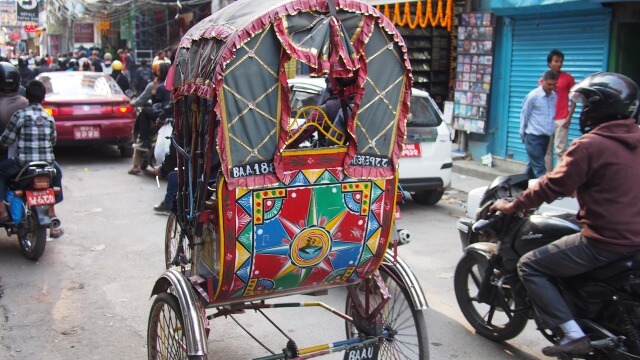
Rickshaws: Bicycle rickshaws are the most popular mode of transport in southern Nepal. They are slow, and the fare has to be negotiated with the driver. Many smaller towns use rickshaws instead of taxis. These are convenient means of transport for short distances within a city and are relatively safe; however, they are likely to be vulnerable in a collision with any larger vehicle. Avoid travelling in rickshaws when long distances are involved, especially on arterial routes used by heavy vehicles.
Buses: Buses are the most ubiquitous mode of transport and the cheapest. However, they are also among the most dangerous, with frequent accidents. Bus services are available both in cities and on intercity routes; for the latter, tourist coaches are available that are more comfortable. Long-distance buses are overcrowded, with people sitting on roofs and even travelling with small animals. Insurgents have also targeted buses in low-intensity bomb attacks. Avoid non-essential travel on buses due to poor safety conditions.
Microbuses also operate in the country and although cheaper than regular buses, these often tend to be cramped with people sitting on roofs or hanging from the doors. Like regular buses, poor roads and careless driving mean that the accident rate is high. Travelling on microbuses is not recommended.
Motorcycle Taxis: Motorcycles are by far the most common vehicle on the road, but they are not recommended due to potholed roads and unpredictable drivers.
Taxis: The best taxi service in Nepal is available in the capital Kathmandu and its neighbouring district Lalitpur, where taxis are plentiful and work throughout the night. 'Private' taxis take single passengers and are the safest means of transport on Nepal's roads. They go by meter and are generally safe and reliable. After 20:00 local time, the fare is one and a half times the daytime fare. The meters are usually adjusted accordingly, and you have to pay what the meter reads, without any extra payment. However, some drivers are known to tamper with the meter; deboard the taxi if the meter fare seems to be increasing too quickly. Outside Kathmandu Valley where the number of taxis is less, you could ask your hotel to arrange a private car for you.
Online ride-hailing app services, namely Pathao or InDrive, are more recommended than traditional taxis when possible as they have a fixed fare and are safer.
Landsinformationen på denna webbplats har översatts med hjälp av maskinöversättning av vår partner. Arbete har utförts för att tillhandahålla en så korrekt översättning som möjligt, dock ska du som läsare ha i åtanke och acceptera att ingen automatisk översättning är perfekt och bör inte heller läsas eller tolkas som så. Landsinformationen är inte avsedd att vara en källa till råd eller handling baserat på det material som presenteras. Ingen garanti antyds eller ges, inga anspråk eller rättsliga åtgärder accepteras.

- {{originalfilename}} x
Närmaste servicekontor
Euro-Center Bangkok
Kan jag boka försäkring till landet?
Våra försäkringar gäller inte vid resa till område som Utrikesdepartementet i sina rekommendationer avråder från att besöka eller vistas i. Vänligen se listan UD avråder för mer information.