

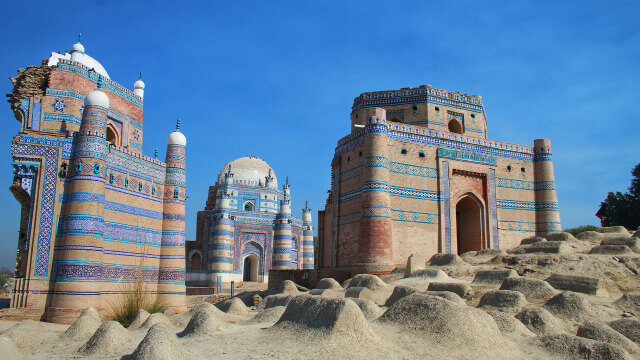
Översikt
Capital: Islamabad (pop. 1.232 million)
Population: 255,219,554 (2025 est.)
Other Urban Areas: Karachi (pop. 17.236 million); Lahore (pop. 13.979 million); Faisalabad (pop. 3.711 million); Gujranwala (pop. 2.415 million); Peshawar (pop. 2.412 million)
Religions: Muslim (official) 96.5% (Sunni 85-90%, Shia 10-15%), other (includes Christian and Hindu) 3.5%
Languages: Punjabi, Sindhi, Pashto, Urdu, Balochi, Hindko, English
Time Zone: UTC+5
Driving side: Left
Calling code: +92
Electrical plug(s): Type C, Type D, Type G and Type M
Pengar
The local currency in Pakistan is Pakistani rupees (PKR). As of 6 October 2026 100 PKR is equal to 0.36 USD.
Currency exchange can be done at airports, banks and exchange offices.
Travellers should be prepared to use cash to make payments. The economy generally operates on a cash-only basis. Credit cards are accepted in upscale and/or tourist areas only. ATMs are only available in urban and/or tourist areas.
Banking hours are from 09:00 to 17:00 Monday to Friday. Saturday 09:00 to 13:30. There is one hour prayer break on Friday.
Tipping about 30-50 rupees at local restaurants is greatly appreciated. It is best to tip hotel staff directly or leave small change on the table of your hotel room. Taxis do not usually expect a tip.
El
The power supply in Pakistan is not reliable. Electricity operates on 230V at 50Hz using plug type(s) C, D, G and M. The country is prone to frequent power outages, even in major urban centres. Pakistan suffers from sporadic outages as supply fails to keep up with demand, particularly during the summer months. Travellers may consider taking batteries with them and ensuring access to a back-up power generators.
Pass
Most travellers will need a passport to enter Pakistan. The passport must be valid for at least six months after the date of arrival and have two blank pages.
Visum
Visa-free entry is available for certain travellers who qualify based on nationality and purpose of travel. Travellers may qualify for a visa waiver, however this requires the completion of a security check or travel authorisation prior to departure. A visa on arrival scheme is in place for select travellers, but often depends on nationality, purpose of travel and port of entry. All other travellers will need to obtain a visa from the nearest embassy or consulate or apply online (e-visa) prior to travel.
Entry visa requirements vary based on nationality, purpose of travel and other factors. Individual travellers are responsible for ensuring that they comply with all visa requirements, which should be confirmed with authorities at their destination prior to travel.
Visa Free Travel
Visa-free entry (GCC nationals): Nationals of the Gulf Cooperation Council (GCC), namely Saudi Arabia, Bahrain, Qatar, Oman, Kuwait and the United Arab Emirates (UAE), are allowed to enter Pakistan for travel and business purposes without a visa for up to 90 days.
Visa Waivers
SAARC Visa Exemption Scheme: Under the South Asian Association for Regional Cooperation (SAARC) visa exemption scheme, eligible businessmen, journalists and government officials may travel visa-free to member states of SAARC. Eligible nationals will be issued an SAARC Visa Exemption Sticker or a special travel document.
From 23 April 2025, the authorities of India and Pakistan suspended the SAARC visa waiver scheme for Indian and Pakistani nationals.
e-Visas
Pakistan Online Visa: Nationals of select countries may apply for an eVisa (Pakistan Online Visa). Holders of a tourist visa may stay in Pakistan for up to three months.
Nationals of many countries eligible for the Pakistan Online Visa are also eligible for the Visa Prior to Arrival (VPA) scheme. VPA visas are issued within 24 hours of application and are free of charge. The VPA scheme is different from the Pakistan Online Visa, which charges a visa fee.
Visas on Arrival
Visa on arrival: Foreign nationals from select countries can apply for an on-arrival visa (VoA) valid for 30 days. Authorities do not specify the maximum duration of the stay.
Visas
Entry visa: Travellers who are not eligible for the eVisas must obtain an entry visa via a Pakistani Embassy.
Travellers may apply for a single-entry visit for up to 90 days. A double entry visa is available for holders of a passport from select countries. Various tourism visas with varying durations are available for different purposes; for additional information go here.
Travellers are advised to consult via the embassy or consular services prior to departure.
Lokal resor
Overview
Pakistan's main international airports are Jinnah International Airport (KHI/OPKC) in Karachi, Alama Iqbal International Airport (LHE/OPLA) in Lahore and Islamabad International Airport (ISB/OPIS) in Islamabad. In recent years, domestic air carriers and trains have been involved in fatal accidents, indicating low safety standards in aviation and railways. Public buses and trains are also frequently subject to accidents due to poor vehicle conditions. Public transportation in cities is limited to buses and taxis. Self-driving can be dangerous outside large cities due to poor road safety standards and difficult terrain.
Travel Safety
Air Travel
Pakistan's major international airports are Jinnah International Airport (KHI/OPKC) located about 20 km (12.4 miles) east of Karachi, Alama Iqbal International Airport (LHE/OPLA) located about 15 km (9.3 miles) from Lahore and Islamabad International Airport (ISB/OPIS) located about 25 km (16 miles) south-west of Islamabad. The country's national carrier, Pakistan International Airlines (PIA), is not currently permitted to fly to and from the United States due to its failure to adhere to international safety standards. In November 2024, the European Union Aviation Safety Agency lifted a four-year ban on PIA, while the United Kingdom Flight Safety Committee lifted a five-year ban on Pakistani airlines in July. Travellers are advised that security is tight at Pakistani airports as militants have previously carried out fatal attacks targeting Karachi's Jinnah International Airport (KHI/OPKC) and Peshawar's Bacha Khan International Airport (PEW/OPPS). Travellers are recommended to use taxis rather than public bus services to and from the airport.
Other major airports in the country are Multan International Airport (MUX/OPMT), Quetta International Airport (UET/OPQT), Faisalabad International Airport (LYP/OPFA) and Bacha Khan International Airport (PMA/OPPS).
Airspace
Expect disruptions to flights amid the military escalation between India and Pakistan. Effective from 24 April 2025 until at least 23 October, Pakistani officials closed Pakistan's airspace to all Indian-owned and Indian-operated airlines.
Borders and Entry
Entry bans:
- Israeli passport holders are banned from entry.
- On 24 April 2025, the South Asian Association for Regional Cooperation (SAARC) visa exemption scheme for Indian nationals was suspended, and travellers under the scheme were ordered to leave the country within 48 hours.
Border closures:
-
Borders with Afghanistan: The Kharlachi and Ghulam Khan border crossings between Afghanistan and Pakistan’s Khyber Pakhtunkhwa province are closed. The Torkham crossing between Afghanistan and Pakistan’s Khyber Pakhtunkhwa province is closed as of 27 March; earlier it was closed to most people, except for Afghan nationals entering Afghanistan, cargo and humanitarian aid. From 11 June, the crossing will be reopened for returning Pakistani motorists and transporters from Afghanistan. The border crossings between Pakistan’s Chaman district, Balochistan province, and Afghanistan’s Spin Boldak district, Kandahar province, partially reopened to migrants returning to Pakistan and cargo trucks after closure due to clashes along the two countries' border.
-
Borders with India: The Attari-Wagah border crossing between India and Lahore district in Pakistan's Punjab province is closed until further notice, in response to a deadly terror attack in Pahalgam, India, by Pakistan-based The Resistance Front (TRF) militants on 22 April 2025. However, Pakistani officials partially reopened the crossing on 2 May 2025 to facilitate the return of stranded Pakistani citizens. The Suchetgarh and Chamliyal border posts between India and Sialkot in Pakistan's Punjab were closed to civilians until further notice as of 25 April 2025.
-
Borders with Iran: The border crossing between Iran’s Pishin in Sistan and Baluchestan province and Pakistan’s Mand in Balochistan province was reportedly closed on 22 September after a large number of armed men took control of parts of Mand tehsil.
Health-related surveillance measures: Authorities implemented Ebola surveillance measures at the country’s entry points, effective until further notice, to prevent the entry of the disease.
Identification
Most travellers will need a passport to enter Pakistan. The passport must be valid for at least six months after the date of arrival and have two blank pages.
Travellers are allowed entry with passports where gender is indicated as "neutral", but the country's laws on LGBTQ people are conservative, and overall social acceptance is low. Lesbian, gay, bisexual, transgender and queer travellers in Pakistan might face legal and social difficulties.
Exit
Polio-related requirements
Authorities required outbound foreign nationals who have remained in Pakistan for more than four weeks and all Pakistani nationals to provide valid polio vaccination cards at airports nationwide. Air passengers must carry the updated online polio cards, as the old version is no longer accepted.
Website and applications for vaccination proof
Travellers may provide proof of their vaccination records via mobile applications available for iOS and Android devices.
Road Travel
Traffic moves on the left in Pakistan. The speed limit is 50 kph (31 mph) in rural areas, 80 kph (50 mph) in urban areas and 120 kph (74 mph) on motorways. It's illegal to drive with a blood alcohol level above zero. Pakistan boasts several motorways that run between major cities. Although well-paved, accidents occur regularly on long, straight stretches of roads due to excessive speed and generally poor driving standards. Rural roads are generally poorly maintained. Animals and careless pedestrians walking on the road make night driving on unlit back roads dangerous.
Rail Travel
Pakistan Railways operates train services in Pakistan. Trains in Pakistan offer different class categories. Air-conditioned classes offer bunks in compartments for up to six people, while non-air-conditioned classes have generally more crowded seats. Schedules and fares are available on the Pakistan Railways website. Pakistan's railways are notorious for numerous fatal accidents due mainly to derailments. In addition, insurgents and militants periodically target the railways with improvised explosive devices (IEDs).
Public Transport
In Pakistan, travellers can benefit from various means of transport. Long-distance buses are a convenient option for moving between cities, while taxis are safer for travelling within cities.
Buses: Several bus companies offer intercity travel between major cities. Daewoo Express is efficient and comfortable, and offers air conditioning in its vehicles. Inter-city bus services are also available by government-owned and private operators. However, long-distance bus travel is not recommended for visitors due to numerous road accidents; passenger buses are also frequently targeted by militants.
Taxis: It is possible to hail a taxi off any major thoroughfare. Negotiating a price is necessary as most taxis do not have meters. Ride-hailing companies such as InDrive and Careem operate in major cities throughout the country.
Vehicle Hire: Local and international car hire firms have offices in major urban centres and airports. However, it is recommended that foreign nationals do not self-drive vehicles due to the volatile security environment. It should be noted that it is possible to hire vehicles with drivers. An International Driver's Licence is necessary to hire a vehicle.
Rickshaws: Those who choose to hire Motorised rickshaws (three-wheelers) or 'tuk-tuk' should negotiate prices in advance. Tuk-tuks are readily available for hire in towns, and most drivers are reliable, even if reckless. This means of transport is only suitable for short and medium-distance travel within the city.
Metro: The centre of Lahore and some outlying areas are served by the Lahore Metro, an automated rapid transit system. The Orange Line and the Metrobus intersect, offering a convenient alternative to avoid traffic jams.
Movement Control Orders
Access to many areas, such as along the Line of Control (LoC) in the disputed territory of Kashmir and border areas of the Balochistan and Khyber-Pakhtunkhwa provinces, is restricted for non-Pakistanis. However, travel to the Khyber Pass is possible with government permission and a government-supplied escort.
Active movement control orders across the country:
Sindh province: Authorities imposed a Section 144 order, which bans protests, demonstrations and gatherings of more than five people, across the province until at least 30 September to maintain public order and security.
- Authorities imposed Section 144 restrictions, including a ban on all kinds of rallies, processions, sit-ins, protests and public gatherings of five or more people across Hyderabad and Sukkur divisions, until at least 29 September to maintain public safety and order.
- Authorities imposed Section 144 restrictions, including a ban on all kinds of rallies, processions, sit-ins, protests and public gatherings of five or more people across Karachi division, until at least 30 September to maintain public safety and order.
Khyber Pakhtunkhwa province:
- Officials partially reopened the Thall-Parachinar Highway, the main road to Kurram district. Earlier, access roads to Kurram were shut due to deadly clashes involving militants since November 2024.
- Authorities imposed a Section 144 order restricting public movement in Tank district from 06:00-18:00 local time (01:00-13:00 GMT), effective until further notice, due to security reasons following an attack on the Manji Khel Joint Checkpost.
- Authorities imposed Section 144 restrictions, including a ban on gatherings of four or more people in Tehsil Shakai, Lower South Waziristan district, effective until 16 October, to maintain law and order.
- Officials imposed a Section 144 order banning the transportation and movement of various types of vehicles in Lower South Waziristan district until 21:00 local time on 10 October.
Muzaffarabad, Azad Jammu and Kashmir (AJK): Authorities imposed Section 144 restrictions, including a ban on all kinds of rallies, processions, sit-ins, protests and public gatherings amid ongoing Joint Awami Action Committee (JAAC) protests.
Balochistan province:
- Authorities imposed Section 144 restrictions on 23 September, including a ban on all kinds of rallies, processions, sit-ins, protests and public gatherings of five or more people until at least 23 October to maintain public safety and order.
- Authorities imposed Section 144 restrictions, including a ban on political gatherings, public meetings, rallies and processions, in Nushki district, effective until further notice to maintain public safety and order.
- Authorities imposed a nightly curfew across the district of Khuzdar from 20:00-10:00 local time (15:00-05:00 GMT) until further notice, due to security concerns.
- Authorities imposed an indefinite curfew in Khadkocha sub-tehsil, Mastung district, effective from 07:00 local time (02:00 GMT) on 23 August until further notice.
Azad Jammu and Kashmir region: Authorities imposed Section 144 restrictions, including a ban on gatherings of five or more people, public meetings, rallies and processions, in the districts of Mirpur and Bhimber.
Punjab province: Authorities imposed restrictions under a Section 144 order, which includes a ban on unsanctioned gatherings of five or more people, until 15 October, citing possible terrorism threats targeting rallies and such gatherings. Tight security measures were implemented in Rawalpindi, Attock, Jhelum and Mianwali.
Islamabad: Authorities imposed Section 144 restrictions on 18 September, including a ban on all kinds of rallies, processions, sit-ins, protests and public gatherings of five or more people until at least 17 November to maintain public safety and order ahead of a planned march by opposition Pakistan Tehreek-e-Insaf members.
State of Emergency: Local authorities imposed a state of emergency (SoE) in Torkham and Landi Kotal Bazaar in Khyber Pakhtunkhwa, due to clashes between Pakistani and Afghan forces.
Curfew: From 29 July, officials are enforcing a curfew, which runs daily from 18:00-06:00 local time (13:00-01:00 GMT) in Nushki district, Balochistan province, until further notice. A section 144 order, banning public gatherings, processions and assemblies of more than four people, was also imposed in the district.
Landsinformationen på denna webbplats har översatts med hjälp av maskinöversättning av vår partner. Arbete har utförts för att tillhandahålla en så korrekt översättning som möjligt, dock ska du som läsare ha i åtanke och acceptera att ingen automatisk översättning är perfekt och bör inte heller läsas eller tolkas som så. Landsinformationen är inte avsedd att vara en källa till råd eller handling baserat på det material som presenteras. Ingen garanti antyds eller ges, inga anspråk eller rättsliga åtgärder accepteras.

- {{originalfilename}} x
Närmaste servicekontor
Euro-Center Bangkok
Kan jag boka försäkring till landet?
Våra försäkringar gäller inte vid resa till område som Utrikesdepartementet i sina rekommendationer avråder från att besöka eller vistas i. Vänligen se listan UD avråder för mer information.